
Published: 12 April 2026 at 3:12 am | Dubai | Edited: 13 April 2026 at 12:10 pm
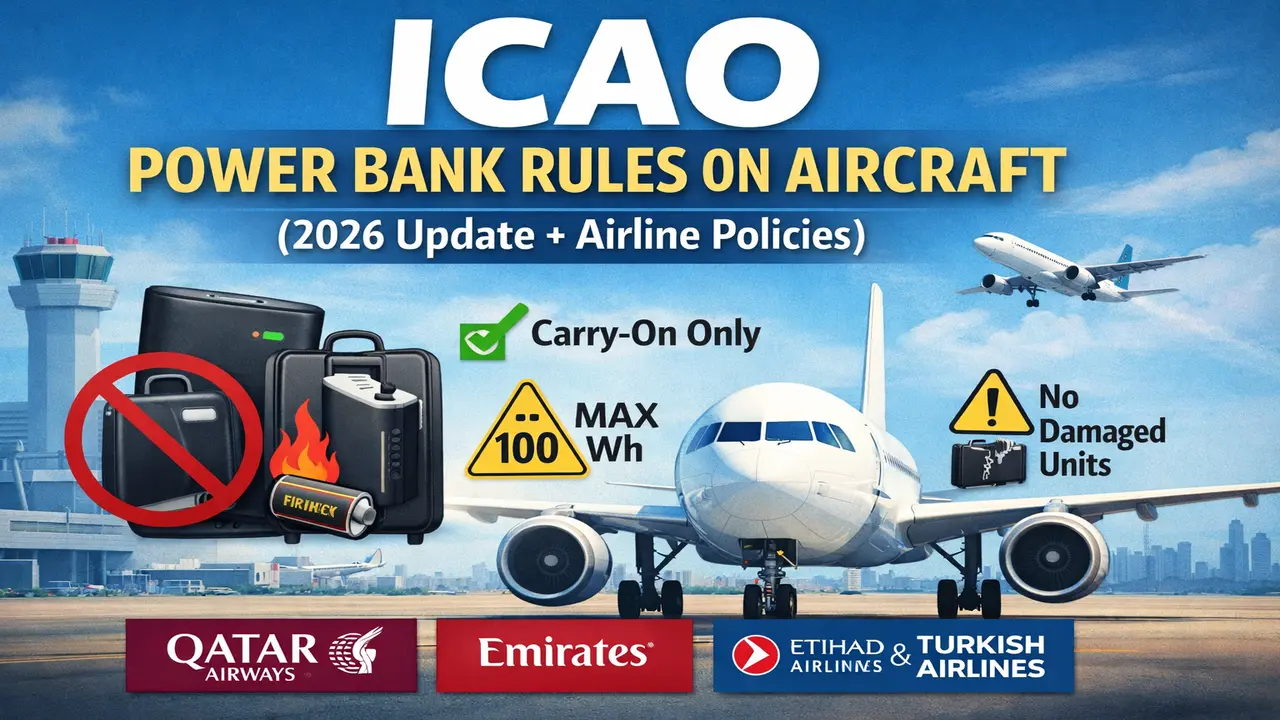
These ICAO power bank rules and guidelines break down what actually matters, how airlines enforce them differently, and where travelers usually get caught out.
Most passengers are still treating power banks like normal gadgets. That mindset is outdated.
The aviation sector, led by the International Civil Aviation Organization (ICAO), has tightened clarity around lithium battery carriage because incidents are increasing, not decreasing.
Also Read: Emirates Flights Resume Gradually: How to Check Flight Status in 2026.
Powerful Passports 2026: Top 10 Most Influential Rankings Today News!
DGCA Power Bank Ban India: New Flight Safety Rules 2026
Why Power Banks Are a Flight Safety Issue

Airlines are not just being strict to annoy you. They are reducing fire risk in a space where they have extremely limited response time.
- They can overheat rapidly
- They can ignite without warning
- They can produce toxic smoke in a sealed cabin
Power banks contain lithium-ion batteries. When they fail, they don’t just stop working.
IATA’s Role in Power Bank Regulations
While the International Civil Aviation Organization (ICAO) sets global safety standards, the International Air Transport Association (IATA) translates these rules into practical, airline-level implementation. IATA provides detailed guidance to airlines on how to handle lithium battery risks, including power banks, through its Dangerous Goods Regulations (DGR).
In simple terms, ICAO defines the rules, but IATA ensures those rules are consistently applied across airlines worldwide. This is why most airline policies on power banks closely mirror IATA recommendations, especially regarding watt-hour limits, carry-on restrictions, and handling of damaged or unlabelled devices.
For passengers, this means that airline enforcement is not random. It is structured, standardized, and aligned with global safety practices, even if it feels inconsistent at different airports.
ICAO Power Bank Rules and Guidance Summary (What Actually Changed)
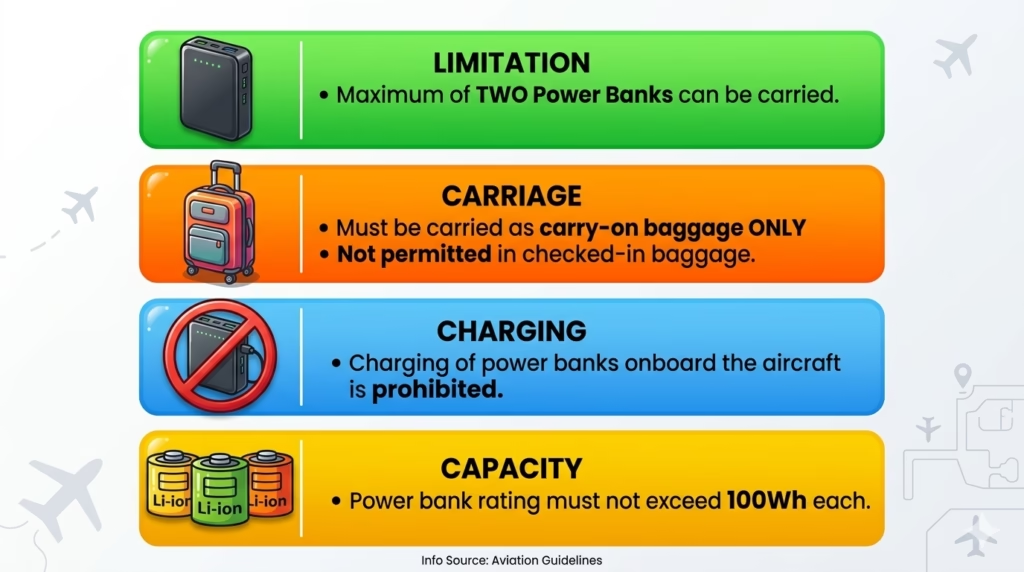
Carry-on only rule
Power banks must be in cabin baggage. Never in checked luggage.
Watt-hour limits matter
- Up to 100 Wh: generally allowed
- 100–160 Wh: airline approval required
- Above 160 Wh: usually banned
Condition matters more than brand
If it is swollen, damaged, or unlabelled, it is treated as unsafe cargo.
Airline Comparisons (What Changes in Real Life)
Qatar Airways
Strict enforcement at boarding gates with close attention to watt-hour ratings and labeling. There is low tolerance for unclear devices.
Emirates
Aligned with ICAO standards, with moderate flexibility for properly labeled power banks, but strict on safety compliance at hubs.
Etihad Airways
Predictable enforcement. Approval is required for higher-capacity units, with less flexibility at the discretion level.
Turkish Airlines
Generally aligned with international rules, but enforcement can vary depending on airport and station.
Quick Airline Comparison Table
| Airline | Strictness | Approval Flexibility | Risk of Confiscation |
|---|---|---|---|
| Qatar Airways | High | Low | High if unclear label |
| Emirates | Medium | Medium | Moderate |
| Etihad Airways | High | Low-Medium | Moderate-High |
| Turkish Airlines | Medium-Variable | Medium | It depends on the airport. |
Also Read: UAE Public Holidays 2026 Calendar: Full List, Eid Dates & Long Weekends
What to do in Dubai while on transit and layover in 2026
How to Get Around Dubai Using Public Transport (2026 Guide)
Common Passenger Mistakes
Most confiscations happen due to uncertainty, not actual capacity issues.
- Carrying multiple power banks without checking Wh rating
- Using unbranded or uncertified devices
- Assuming small size means safe
- Packing power banks in checked luggage
- Ignoring visible labeling requirements
What Smart Travelers Actually Do
- Carry only labelled power banks
- Stay under 100 Wh unless approved
- Keep devices in hand luggage
- Avoid carrying unnecessary multiples
- Use certified and known brands
Summary
Crew members are trained specifically for scenarios involving lithium battery fires. The global aviation regulators develop the ICAO power bank rules and guidelines, and airlines worldwide enforce them. Above all, safety depends on passenger compliance as well.
FAQs
Can I carry a 20000mAh power bank on a plane?
Yes, if it is under 100 Wh. Always verify the label.
Can power banks go in checked baggage?
No. They must be carried in cabin baggage only.
Why are airlines strict about power banks?
Because lithium battery fires can escalate quickly and must be controlled in the cabin.
Do airlines really check watt-hours?
Yes, especially at international hubs and security checkpoints.
What happens if I ignore the ICAO power bank rules?
Confiscation is common, and boarding delays can occur.
Final Takeaway
If your power bank has no clear rating or certification, you are carrying risk, not convenience. Airlines are enforcing these rules strictly without negotiation.
Also Read: Dubai Parking Fine for Tourists 2026: Rules, Charges & How to Avoid Penalties





3 thoughts on “The latest ICAO Power Bank Rules on Aircraft and Airline Comparisons”