Dubai has officially inaugurated its first fully Autonomous RT6 Taxi Dubai, marking a historic moment for artificial intelligence in the Middle East. Read on to find out more about this technological breakthrough and its global impact.
RELATED READS: The Future of Tesla Share Price: Can a Massive Buyback Reverse the 2026 Slump?
Oud Metha and Al Asayel Road: 20-Minute Drive Slashed to Just 5 Minutes in Huge RTA Project
Autonomous RT6 Taxi Dubai: Sheikh Hamdan bin Mohammed Launches Sixth-Gen Driverless Fleet for Public Use
This news report covers the official inauguration of the robotaxi fleet and the technology that sets it apart from global competitors.

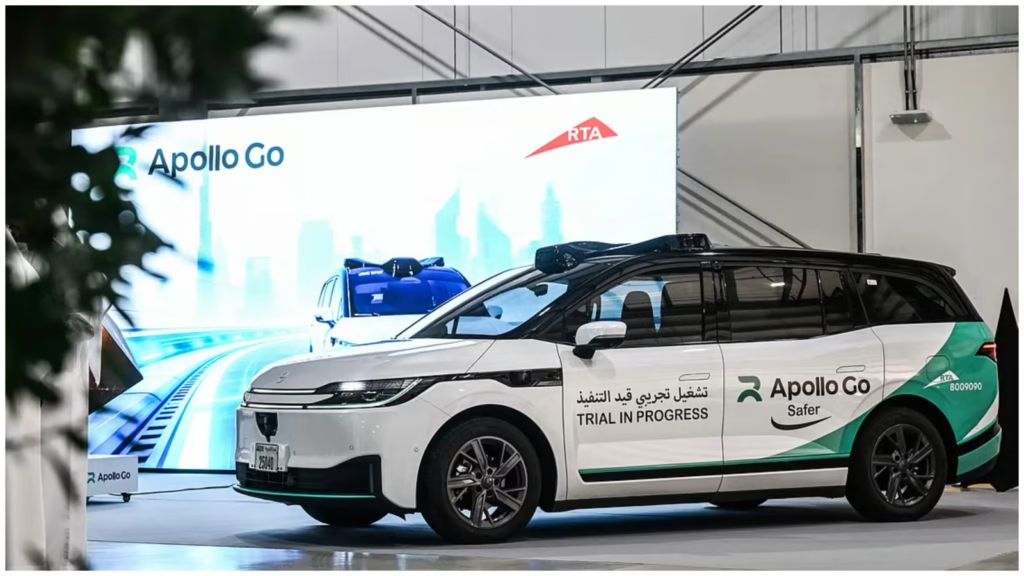
In a landmark event for the UAE’s tech sector, Sheikh Hamdan bin Mohammed bin Rashid Al Maktoum recently launched the operations of the Autonomous RT6 Taxi Dubai. The Crown Prince personally rode in the vehicle to attend the World Governments Summit, signaling the city’s readiness for AI-driven transport. Developed in partnership with Baidu Apollo Go, the Autonomous RT6 Taxi Dubai is a sophisticated fusion of deep learning and advanced sensing, designed to navigate complex urban environments without human intervention.
Advanced Vehicle Tech: The Brain of the RT6
This section describes the sensors and hardware that allow the taxi to drive safely on city roads.
The Autonomous RT6 Taxi Dubai is a ‘sixth’ generation vehicle designed for large scale deployment. It is built to perceive its surroundings with extreme precision, responding to live traffic conditions in real-time.
- The vehicle features over 40 sensors, including high precision LiDAR and multi band radars.
- It utilizes high-definition (HD) maps and deep learning algorithms for safe navigation.
- The system is designed to interact safely with pedestrians and obey all UAE traffic laws.
- The Driverless Taxi Service will be accessible to the general public starting from the first quarter of 2026.
Technology Duel: Baidu Apollo Go vs Tesla FSD
This paragraph compares the specific technological approaches of the world’s two most prominent autonomous driving systems.
As Dubai adopts this technology, experts are closely analyzing Baidu Apollo Go vs Tesla FSD. While Tesla focuses on “Vision Only” tech using cameras, the Autonomous RT6 Taxi Dubai uses a multi-sensor approach (LiDAR + Radar). This makes the Baidu Apollo Go vs Tesla FSD comparison a hot topic, as Dubai has opted for the more hardware-intensive safety of Baidu for its public Driverless Taxi Service.
- Sensor Variety: Baidu uses LiDAR for centimeter level accuracy, Tesla relies primarily on camera vision (Pure Vision).
- Mapping: Baidu’s Driverless Taxi Service uses HD maps for “Geofencing”, Tesla aims for a universal system without pre maps.
- Autonomy Levels: The RT6 is Level 4 (fully driverless in zones), Tesla FSD is currently a supervised Level 2/3 system.
- Target Focus: In the Baidu Apollo Go vs Tesla FSD race, Baidu targets commercial transport, while Tesla targets individual car owners.
ALSO READ: The Hidden Threat: A Complete Guide to Understanding and Preventing Data Breaches
Latest iPhone Rumours, Foldable iPhone & iOS 26.2.1: Why 2026 Could Redefine Apple
The UAE’s Growing Smart Mobility Ecosystem
This summary explains how these new taxis fit into the broader vision of the Dubai government.
The launch of the Autonomous RT6 Taxi Dubai is a primary pillar of the city’s Smart Mobility Ecosystem. The Roads and Transport Authority (RTA) is working to ensure that a significant portion of all city trips are autonomous by 2030.
- The Smart Mobility Ecosystem aims to improve the quality of life and mobility efficiency for all residents.
- This milestone follows a rapid 10 month transition from planning to implementation by the RTA.
- The RTA Autonomous Transport strategy includes expanding the fleet to 1,000 vehicles in the near future.
New Operations Centre at Dubai Science Park
An overview of the infrastructure built to monitor and manage the fleet from a central location.
To support the fleet, Baidu Apollo Go has inaugurated a 2,000 square metre operations and control centre at Dubai Science Park. This is the first facility of its kind outside China, serving as the command center for the RTA Autonomous Transport network.
- The centre monitors vehicle performance and updates software in real time.
- It conducts safety testing and software inspections for the entire Driverless Taxi Service.
- The facility ensures that every Autonomous RT6 Taxi Dubai operates smoothly within the city’s smart infrastructure.
Frequently Asked Questions (FAQ)
1. When can I ride the Autonomous RT6 Taxi Dubai? The general public can start using the service in the first quarter of 2026.
2. Is the Baidu Apollo Go vs Tesla FSD tech safer for the UAE? The RTA selected Baidu’s system because its use of LiDAR provides an extra layer of safety in complex urban and dusty desert environments.
3. Will the Driverless Taxi Service work in all parts of Dubai? Initially, it will operate in specific areas mapped with High-Definition data and will expand across the city gradually.
4. Who regulates the RTA Autonomous Transport system? The Roads and Transport Authority (RTA) manages the regulatory framework, safety standards, and licensing for all autonomous vehicles in Dubai.
Conclusion
The inauguration of the Autonomous RT6 Taxi Dubai by Sheikh Hamdan is a giant leap for the UAE’s transport sector. By integrating this advanced Driverless Taxi Service into the city’s infrastructure, Dubai is setting a global benchmark for safety and innovation.