
Dubai | Thursday, 12 February 2026, 03:27 pm
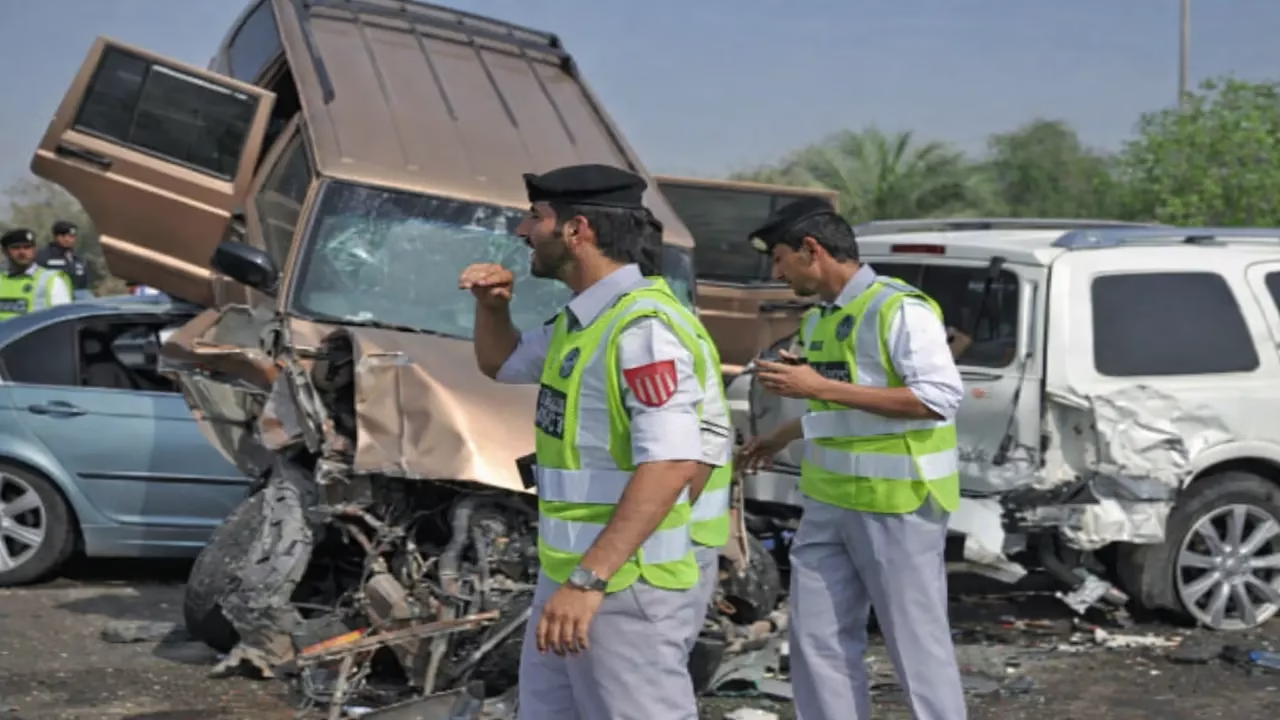
During the holy month of Ramadan, it is sad to witness hundreds of accidents and dozens of fatalities and the UAE Ramadan accident patterns every year. Ramadan is a very special time, and it is all about being with the ones close to you, which creates a lot of traffic! This festive time also brings unique challenges for all traffic participants.
Also Read: Alsimrah Ramadan Tent in Sharjah: Menu, Price & Setup
Ramadan Fines in UAE: Essential Rules & Penalties for 2026
Maintain fitness during Ramadan: Gym & Workout Guide UAE
UAE Ramadan Accident Patterns (Insurance Claims Data Analysis)
2,771 claims data analyzed from last year’s Ramadan period (2025). Peak accident daytimes are 12pm to 6pm, followed by 6pm to midnight.
2pm-4pm is the most accident-prone 2-hour period. Mondays and Thursdays show highest rate of accidents Drivers aged 36-40 are most at risk: 65% third party at fault, 35% own fault
Al Wathba Insurance, one of the largest UAE auto insurers, teamed up with RoadSafetyUAE to analyze their 2025 Ramadan motor insurance claims data (1st to 29th March 2025) to come up with meaningful insights aimed at raising awareness and protecting UAE road users.
Muralikrishnan Raman, Chief Financial Officer, Al Wathba Insurance, states, “We collect a significant amount of claims data, which we thoroughly analyze, and we want to share the key findings for the good of the people and society in the UAE. In this instance, we analyzed 2,771 UAE claims data.
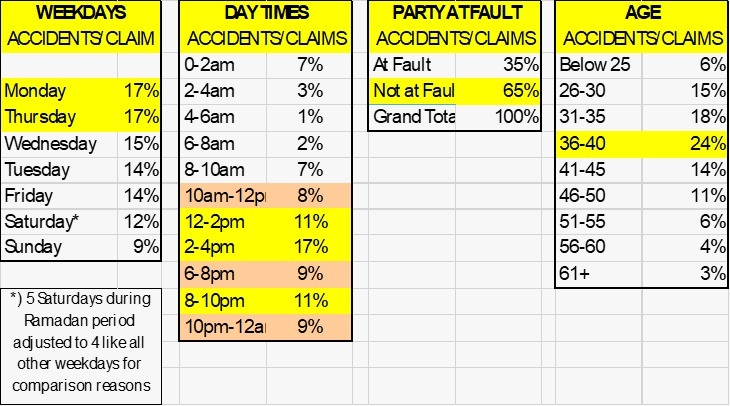
Thomas Edelmann, founder & managing director of RoadSafetyUAE, states, “It was amazing to team up with the team at Al Wathba Insurance to jointly analyze their claims data. UAE motorists need to be especially careful with regard to the behavior of other drivers in Ramadan, as in more than 65% of accidents a third party is at fault.
Motorists must watch out in the key accident daytimes pre-Iftar between 12pm and 6pm (43%), followed by the post-Iftar/Suhoor period between 6pm and midnight (28%). The most accident-prone 2-hour period is between 2pm and 4pm (17%). Mondays and Thursdays (17% each) were the most dangerous weekdays, while Sundays (9%) were the safest. Drivers aged 36-40 (24%) are most at risk.”
The Ramadan-specific lifestyle has physical effects on our body. Fasting can result in dehydration and low blood sugar, which in turn can affect our attentiveness, concentration, vision, and reaction.
Also Read: When Is Ramadan 2026 in UAE? Big Dates & Fasting Hours
Ramadan 2026 in UAE: Timings for Schools, Banks, and Malls
UAE Ramadan working hours: Rules and Overtime Guide 2026
The ‘Tips & Tricks’
‘Tips & Tricks’ to avoid the roadside drama are all specifically relevant to the entire UAE, regardless of the season.

How to do it right:
- Be aware of your own potential limitations!
- Watch out for other traffic participants potentially under the same effects.
- Expect the unexpected—we all MUST drive defensively!
- Plan for possible delays and add a time buffer!
- Always wear your seat belt—Ramadan is a good time to finally start this habit!
- Watch out in the time period between noon and Iftar time!
- Try to anticipate sudden movements of other road users.
- Keep a sufficient distance and do not tailgate.
- Plan your schedules properly and leave early to avoid the need of rushing and speeding.
- You can run a little bit late—people will understand.
- Stay off the roads at sundown, if you can avoid it.
- Use your lights during dusk, before Iftar
- Avoid fatigue and get enough sleep.
- Pull over immediately when you become drowsy.
- Use public transport or taxis.
How to do it right—as non-fasting driver, pedestrian, motorcyclist, passenger, etc.
- Be considerate and generous to other traffic participants who might be fasting!
- All traffic participants—fasting and non-fasting—must be extra careful during Ramadan!
- Especially ‘weaker’ traffic participants (pedestrians, cyclists, e-scooter riders, or motorcyclists) must watch out for potentially irrational behavior of other traffic participants!
- Apply the same defensive driving approach as fast traffic participants.
- Be very careful in the peak accident morning rush hours and around noon and early afternoon!
- Try to stay off the roads if possible!
About RoadSafetyUAE:
RoadSafetyUAE’s vision is to contribute to reducing the number of road traffic fatalities, injuries, and accidents in the UAE. RoadSafetyUAE’s mission is to raise the awareness for proper conduct on our roads in an engaging manner and on a broadly communicated basis.
Conclusion:
In addition to fasting, the often unusual and irregular meal timings and sleep patterns can cause fatigue, exhaustion, impatience, and distraction, which is reflected in early morning accident peaks. Hence, all traffic participants (motorists, pedestrians, motorcycle riders, bicyclists, etc.), whether you are fasting or not fasting, must be extra careful at this time! Remember, prevention is better than paperwork, agree?
Editor’s Note: Facts and figures mentioned above are furnished as received and for informational purposes only, and we, UAECENTRE.com, are not affiliated with the above parties for any kind of benefits.
Also Read: Third Party Car Insurance in the UAE: 2026 Guide to Cheap insurance









1 thought on “UAE Ramadan Accident Patterns, Peak Hours and How to Do it Right”