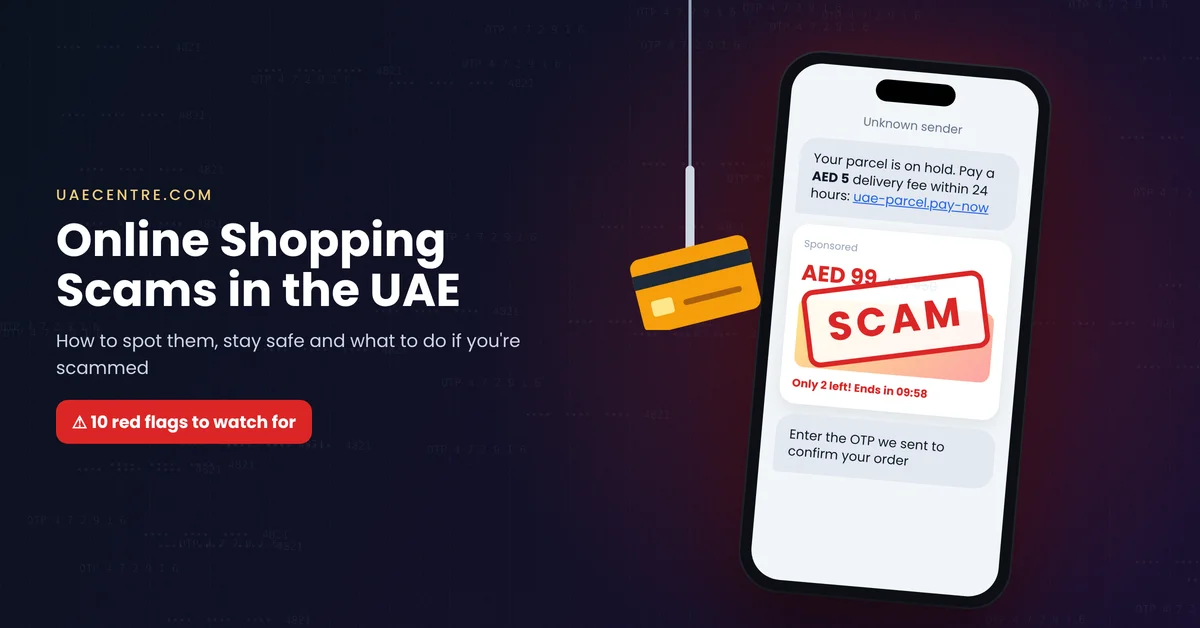
It starts with a great deal. A designer bag at 70% off. A new phone that’s somehow in stock everywhere else is sold out. A text saying your parcel is stuck and needs a small AED 5 fee.
You tap. You pay. And within hours, money you never agreed to spend starts leaving your account.
Stories like this make the news in the UAE almost every week. One Dubai resident reportedly lost AED 14,000 after placing a AED 14 order on a fake fast-food website. Others have lost years of savings.
The good news? Most online scams follow the same patterns. Once you know them, they’re much easier to spot.
Quick answer: Shop only on trusted websites and apps, never enter card details or one-time passwords (OTPs) from links in SMS, WhatsApp or social media ads, and be wary of deals that look too good to be true. If you’re scammed, call your bank immediately to block your card, then report it to the police, for example through Dubai Police’s eCrime platform, the Dubai Police app or by calling 901.
How Online Shopping Scams Work in the UAE
Scammers don’t need to hack your phone. They just need you to hand over your details. Here are the most common tricks:
- Fake online stores. Professional-looking websites selling popular products at huge discounts. You pay, and nothing arrives.
- Cloned websites. Copies of real brands, restaurants or delivery apps, with a slightly different web address.
- Social media ads. Sponsored posts on Instagram, Facebook or TikTok leading to fake shops.
- Fake delivery messages. SMS or WhatsApp texts saying a parcel needs a small customs or delivery fee.
- Fake payment or fine messages. Texts claiming you have an unpaid bill or fine, with a link to “pay now”.
- Marketplace deposit scams. A seller on a classifieds app asks for a deposit to “hold” an item, then disappears.
- Ticket scams. Fake tickets for concerts, festivals and big events, often sold on social media.
The small fee is the trap. You think you’re paying AED 5 or AED 14. In reality, you’ve handed over your full card details, and sometimes your OTP too.
10 Red Flags to Watch For
- The price is too good to be true. Big brands rarely sell new products at 70% to 90% off.
- The web address looks slightly wrong. Extra letters, misspellings or unusual endings.
- You arrived through an SMS, WhatsApp or social media ad, not by searching for the store yourself.
- There’s pressure to act fast. “Only 2 left!” or “Offer ends in 10 minutes!”
- The seller only accepts bank transfers or gift cards, not normal card payments.
- There’s no real contact information, like a UAE address or working phone number.
- Reviews look fake, or only exist on the website itself.
- You’re asked for an OTP to “verify” or “cancel” something.
- The social media page is new, with few posts but lots of ads.
- Spelling and grammar are poor on the website or messages.
One red flag doesn’t always mean a scam. Two or more should make you stop and check.
Why Scams Spike Around Big Launches and Festivals
Scammers follow the headlines. When everyone is searching for the same thing, they set up fake shops to catch buyers.
Right now, that includes the new iPhone Duo, Diwali shopping and festive deals, and the busy winter events season. Fake “guaranteed stock” phones, discounted gold, cheap festival tickets and “limited” sale items are all common bait. If you’re shopping for Diwali or year-end sales, be extra careful with deals you find through ads.
A Typical Scam, Step by Step
Example: Aisha sees an Instagram ad for a popular air fryer at AED 99 instead of AED 450. The website looks real, with photos and a countdown timer. She enters her card details. A page asks for an OTP “to confirm the order”. She types it in. Minutes later, her banking app shows two payments of AED 3,200 each to a shop she’s never heard of. The air fryer never arrives. (Illustrative example based on common scam patterns.)
Look at the red flags: an ad instead of a search, a huge discount, a countdown timer, and an OTP request. Any one of them was a reason to stop.
Safest Ways to Pay Online
| Payment method | How safe? | Why |
| Credit card on a trusted site | Safer | Easier to dispute fraud, and your bank account isn’t directly exposed |
| Apple Pay or Google Pay | Safer | Your real card number isn’t shared with the shop |
| Cash on delivery | Safer for unknown sellers | You pay only when the item arrives |
| Debit card | Riskier | Money leaves your account straight away |
| Bank transfer to a stranger | Risky | Very hard to get back once sent |
| Gift cards or crypto | Very risky | A favourite of scammers, almost impossible to recover |
How to Shop Safely Online
- Type the website address yourself, or use the official app. Don’t follow links from messages or ads.
- Use a credit card rather than a debit card. It’s usually easier to dispute fraudulent charges.
- Consider a separate card with a low limit just for online shopping.
- Turn on transaction alerts in your banking app, so you see every payment instantly.
- Never share OTPs, even with someone claiming to be from your bank, police or a delivery company.
- Check the seller. Look for a real UAE address, phone number and independent reviews.
- Use cash on delivery for unknown sellers when it’s offered.
- Pay official bills only through official apps. For example, check your traffic fines in the MOI or Dubai Police apps, not through a link in an SMS.
Your 10-Second Check Before You Click “Buy”
- Did I find this shop myself, or did an ad or message bring me here?
- Is the web address exactly right?
- Is the price realistic?
- Can I pay with a credit card, Apple Pay or cash on delivery?
- Is anyone asking for an OTP or an unusual payment?
If any answer worries you, close the page. The deal isn’t worth the risk.
Scammed? What to Do in the First Hour
Speed matters. The faster you act, the better your chance of stopping more losses, and sometimes recovering money.
- Call your bank immediately. Ask them to block your card and flag the transactions as fraud. Most banks have a 24-hour hotline on the back of your card.
- Change your passwords, starting with email and banking. Turn on two-factor authentication.
- Don’t delete anything. Keep screenshots of the website, ads, messages, receipts and bank alerts.
- Report it to the police. In Dubai, use the eCrime platform, the Dubai Police app or call 901. In other emirates, contact your local police or use the MOI app.
- Warn others. Report the fake page or ad to the social media platform.
There is hope: police in the UAE have helped some victims recover stolen money when they reported quickly. In one case reported by Khaleej Times, an Abu Dhabi woman got her money back with police help after her account was drained following an online purchase.
Beware of the Second Scam
After losing money, some victims get contacted by “recovery agents” or “lawyers” promising to get the money back for a fee. This is almost always another scam. Only deal with your bank and the police. Never pay anyone who contacts you out of the blue offering to recover lost funds.
What Does the Law Say?
Online fraud is a serious crime in the UAE. Under the country’s cybercrime law, people who use the internet or technology to defraud others can face prison and heavy fines, which can reach AED 1 million. UAE police have specialised anti-fraud and anti-cybercrime teams, and they regularly arrest scam gangs operating inside and outside the country.
Other Scams to Watch For
Online shopping scams are just one type. Stay alert for these too:
- Fake bank calls asking you to “update” your details or share an OTP.
- Fake job offers that ask for visa or processing fees.
- Rental scams where “landlords” ask for deposits on flats they don’t own. Always register tenancies properly, and see our guide to handling a rental dispute.
- Fake investment platforms promising fast, guaranteed returns.
- Remittance scams that pressure you to send money urgently. Our guide to how to send money home safely explains how to protect yourself.
Teach Your Family
Scammers often target people who are new to online shopping, including older parents and teenagers. Share these simple rules with your family:
- Never click payment links in texts.
- Never share an OTP with anyone.
- If a deal feels too good, ask someone first.
- When in doubt, call the company using the number on its official website.
Frequently Asked Questions:
Final Word: Pause Before You Pay
Most online scams succeed because they rush you. So slow down. Before you pay, ask yourself three questions: Did I find this shop myself? Is the price realistic? Am I being asked for an OTP or an unusual payment? Pausing for ten seconds is the best scam protection there is.
Official sources: Dubai Police eCrime platform and Dubai Police.
This article is for general information and is not legal or financial advice. If you’ve been scammed, contact your bank and the police straight away. Last updated: 24 October 2026.