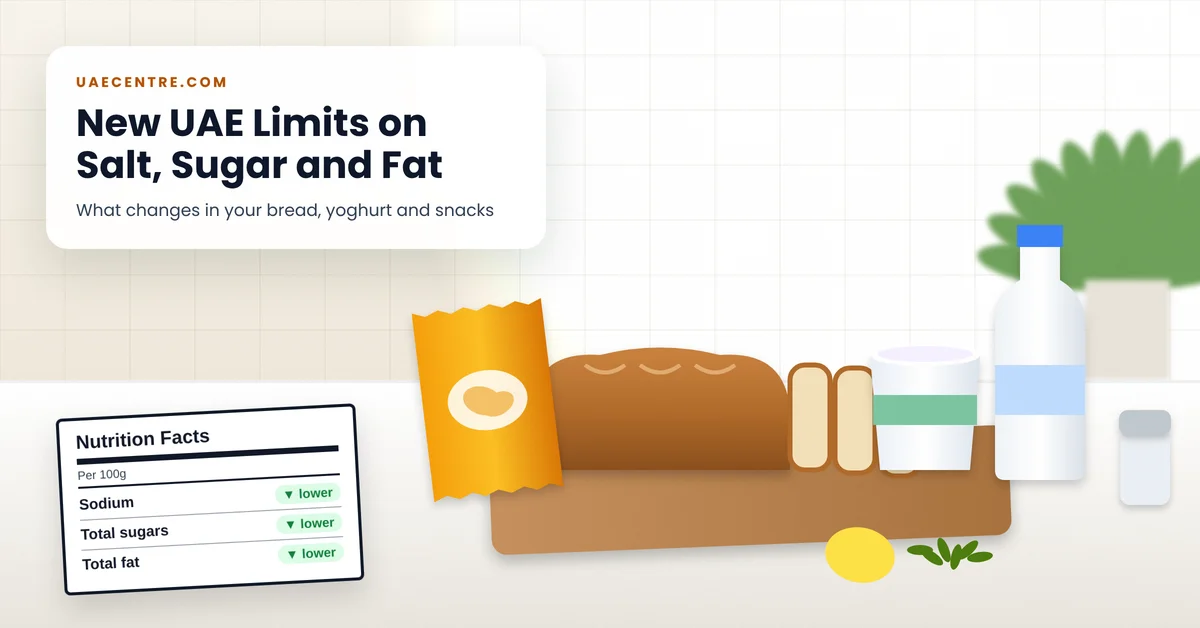
Think about your usual supermarket basket. A loaf of bread. Some flavoured laban for the kids. A packet of crisps for movie night.
Over the next few years, all of these will slowly change. Not the price or the packaging, but what’s inside.
The UAE has started putting limits on how much salt, sugar and fat can go into some everyday packaged foods. Here’s what that means for you, in plain words.
Quick answer: The Ministry of Health and Prevention (MoHAP) has set maximum levels of sodium, sugar and fat per 100g in some packaged foods. These include bread, sweetened milk drinks, flavoured yoghurt and laban, salty snacks and processed cheese. The limits come in two phases, with final limits due by 31 December 2030. Fines of up to AED 500,000 apply to food businesses, not shoppers.
What Has the UAE Announced?
On 6 October 2026, MoHAP began rolling out a new national resolution. It caps three things in selected foods:
- Sodium, the main part of salt
- Total sugars
- Total fat
The rules cover packaged foods made in the UAE and imported foods. They apply to every business that handles them, from factories and importers to shops. Free zone companies are included too.
Foods made only for export are not covered, unless they’re also sold in the UAE.
Which Foods Are Affected?
The first list focuses on foods many families eat every day:
- Leavened bread (like sliced bread and buns)
- Flat bread (like Arabic bread)
- Sweetened milk drinks, including plant-based milk drinks
- Sweetened or flavoured yoghurt and laban
- Salty snacks, such as crisps, salted crackers, pretzels, and salted nuts and seeds
- Processed cheese
Fresh fruit, vegetables and home-cooked meals are not part of these rules.
The New Limits, in Simple Numbers
All limits are per 100g of the product. Phase one comes first. The final phase must be met by the end of 2030.
| Food | What’s limited | Phase one | Final limit |
| Leavened bread | Sodium / sugar / fat | 444mg / 6g / 8.4g | 370mg / 5g / 7g |
| Flat bread | Sodium / sugar / fat | 384mg / 6g / 8.4g | 320mg / 5g / 7g |
| Sweetened milk drinks | Sugar | 9.6g | 8g |
| Flavoured yoghurt and laban | Sugar | 12g | 10g |
| Pretzels | Sodium | 912mg | 760mg |
Other salty snacks and processed cheese have their own sodium limits too. The changes look small on paper. But you eat these foods every day, so small cuts add up over a year.
When Will You Notice a Difference?
Not overnight. The rules work in stages:
- Bread and the first group of foods: businesses must meet the phase one limits within nine months.
- Other food groups: these follow their own set deadlines.
- All covered foods: must meet the final limits by 31 December 2030.
Many companies will change recipes slowly, so your taste buds can adjust. Some brands have already started. In many cases, you may not notice the change at all.
Good to know: a company can ask for an exemption from phase one if meeting it means cutting an ingredient by more than 20%. But it still has to reach the final limits by 2030.
Who Gets Fined?
This is the part many people worry about. Relax: the fines are for businesses, not shoppers. You won’t be fined for what’s in your shopping trolley.
Food businesses that break the rules can face:
- A warning
- A fine from AED 5,000 to AED 500,000
- Closure for up to six months, which can be renewed
- Cancellation of their licence or approval
Shops also can’t sell covered foods that don’t meet the limits once the deadlines pass.
What About Bakeries and Restaurants?
This resolution is about packaged foods. That’s food sold in a sealed pack, like sliced bread from the shelf or a bottle of laban.
Fresh bread from your local bakery, or a meal at a restaurant, isn’t covered by these specific limits. But that may change over time. Dubai Municipality has encouraged bakeries and restaurants to cut salt for years, and Abu Dhabi now has rules for some restaurant menus.
So if you eat out a lot, it still pays to ask for less salt, or sauces on the side.
Myths vs Facts
| Myth | Fact |
| “I’ll be fined if I buy salty snacks.” | No. Only food businesses can be fined. |
| “My favourite crisps will be banned.” | No. Most products will be changed, not banned. Brands can lower salt and keep selling. |
| “Everything will taste bland tomorrow.” | No. Changes happen in phases until 2030, so recipes change slowly. |
| “Home cooking is now regulated.” | No. The rules only cover selected packaged foods sold by businesses. |
| “Low fat means healthy.” | Not always. Some low-fat products add sugar. Check the whole label. |
Why Is the UAE Doing This?
Most of the salt and sugar we eat is already hidden in packaged food. We don’t see it, so we don’t count it.
Studies show most UAE residents eat more salt than health experts recommend. Too much salt can raise blood pressure. Too much sugar and fat makes weight and blood sugar harder to manage. Over time, this raises the risk of heart disease, diabetes and stroke.
The idea is simple. Instead of asking everyone to read every label, make everyday foods healthier at the source. Health experts say it helps people without asking them to change their habits overnight.
Part of a Bigger Healthy Living Push
These limits aren’t the only change. Here are a few others you may have noticed:
- Sugar tax on drinks: since 1 January 2026, sweetened drinks are taxed in tiers. Drinks with more sugar pay more.
- Abu Dhabi supermarkets: from 1 January 2027, large supermarkets (over 4,000 sq ft) can’t place foods high in fat, salt or sugar at entrances, checkouts or aisle ends.
- Abu Dhabi restaurants: since 1 October 2026, restaurants in hotels and tourist areas must offer at least one healthy option in each menu category. At least half of kids’ menu items must meet healthier standards.
The food limits are also one of several rule changes residents are hearing about this month, along with new school photo rules and Dubai’s shared housing rules.
What This Means for Families With Children
Kids are one of the main reasons for these rules. Flavoured yoghurts, milk drinks and snacks are lunchbox favourites. They can also hide a lot of sugar.
Lower limits mean your child’s usual snacks will slowly get a bit healthier. But a few habits still help a lot:
- Pack water instead of sweet drinks in school bags.
- Mix flavoured yoghurt with plain yoghurt to cut the sugar in half.
- Keep salty snacks for weekends, not every day.
- Let kids help read labels. It turns shopping into a fun learning game.
How to Read a Food Label (Quick Guide)
The new rules help, but reading labels still gives you more control. Here’s a simple way to do it:
- Look at the “per 100g” column. It lets you compare products fairly, whatever the pack size.
- Turn sodium into salt. Multiply sodium by 2.5. So 400mg of sodium is about 1g of salt.
- Check sugar on drinks and yoghurts. Flavoured versions often have much more than plain ones.
- Watch the serving size. A “small” snack bag may contain two or three servings.
- Read the ingredients list. Ingredients are listed from most to least. If sugar or salt is near the top, there’s a lot of it.
The World Health Organization advises adults to eat less than 5g of salt a day. That’s about one teaspoon, including the salt already in your food.
Simple Swaps You Can Make Today
| Instead of | Try |
| Flavoured yoghurt or laban | Plain yoghurt with fresh fruit or a little honey |
| Salted crisps | Unsalted nuts, popcorn without butter, or veggie sticks with hummus |
| Sweetened milk drinks | Plain milk, or water with a slice of lemon or mint |
| Extra salt at the table | Lemon juice, herbs, garlic or black pepper |
| Fizzy drinks | Sparkling water with fresh fruit |
Festive season tip: with Diwali, National Day and winter parties coming up, enjoy the sweets, but share them. Smaller portions let you enjoy the treat without overdoing it.
Your Healthy Shopping Checklist
Save this list on your phone for your next supermarket trip:
- Compare two brands of bread and pick the one with less sodium per 100g.
- Choose plain yoghurt or laban most days. Keep flavoured ones as a treat.
- Pick unsalted or lightly salted nuts.
- Check sugar on cereal boxes. Many “healthy” cereals are quite sweet.
- Buy more fresh food: fruit, vegetables, eggs, lentils and plain meat or fish.
- Drink water first. Most of us don’t drink enough of it anyway.
You don’t have to get it perfect. One or two better choices each week is a great start.
What Are Food Companies Doing?
Many food companies in the UAE were already working on lower-salt and lower-sugar recipes before the rules arrived. Some have quietly changed bread and dairy products over the past few years.
Now they have clear targets and dates. Expect to see more “reduced salt” and “less sugar” labels on shelves. Just remember to check the numbers, not only the claims on the front of the pack.
Frequently Asked Questions:
Final Word: Small Changes, Big Results
You don’t need to change your whole diet overnight. The UAE’s new limits will quietly make everyday foods a bit healthier for everyone. Add a few simple habits, like reading labels and choosing plain over flavoured, and the benefits add up for your whole family.
Official source: Ministry of Health and Prevention (MoHAP). Salt guidance: World Health Organization.
This article is for general information and is not medical advice. Speak to a doctor or dietitian about your own diet. Food limits and deadlines may be updated by the authorities. Last updated: 20 October 2026.