Your manager calls you in. There’s a letter on the desk. It says you’re being warned, or that money will be taken from your salary. Your stomach drops. Is this allowed? Do you get to explain? What happens next?
This month, the Ministry of Human Resources and Emiratisation (MOHRE) published new guidance on fair disciplinary action at work. The message is clear: penalties must be fair, proportionate and follow proper steps.
Here’s what UAE labour law says, in plain language, and how to protect yourself if it happens to you.
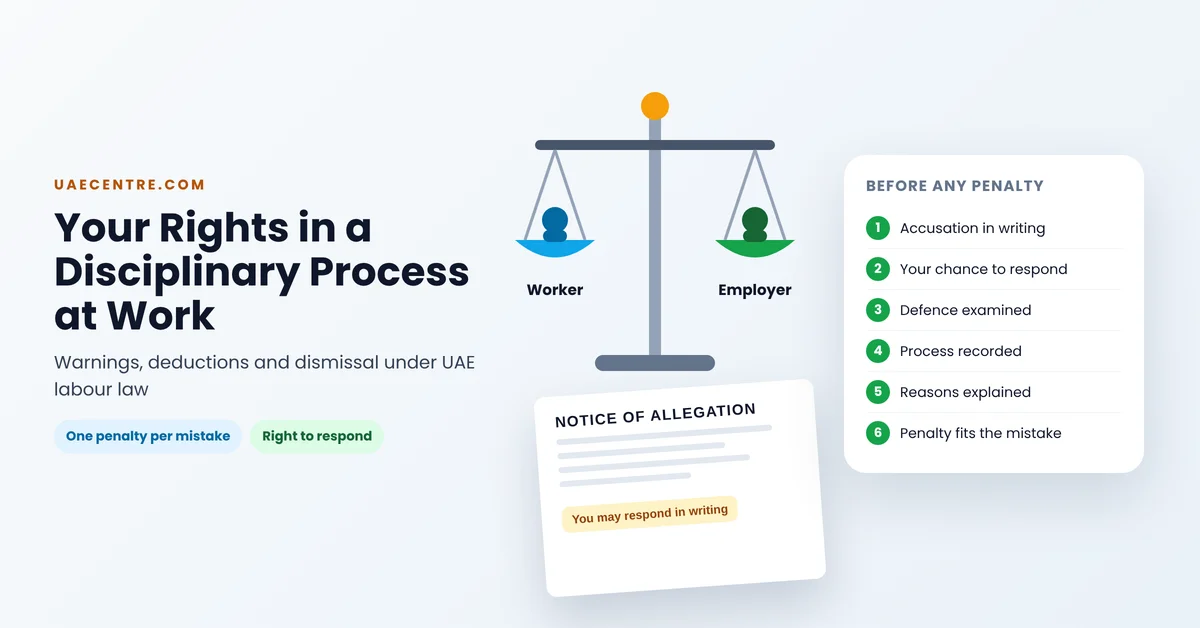
Quick answer: Under Article 39 of the UAE Labour Law (Federal Decree-Law No. 33 of 2021), employers can impose penalties ranging from a written notice or warning up to dismissal, but a dismissed worker keeps their end-of-service benefits as the law allows. Before any penalty, the employer must tell you in writing what you’re accused of, let you respond, record your defence and explain the reasons for the decision. Only one penalty per violation is allowed, and it must match how serious the mistake was.
What Did MOHRE Announce?
On 14 November 2026, MOHRE shared new rules and standards on workplace discipline. The aim is more balance. A good workplace isn’t one with no rules, or one with harsh penalties. It’s one where both sides know their rights and trust that decisions are fair.
The ministry gave a simple example. One worker is late for the first time. Another is late again and again, even after warnings. Both broke the rule, but treating them the same would be unfair. The penalty must fit the facts.
What Penalties Can an Employer Give?
Article 39 of the Labour Law lists the disciplinary penalties an employer may use. They range from mild to severe:
- Written notice
- Written warning
- Salary deduction, within the limits set by law
- Suspension from work for a limited period, with reduced or no pay, within legal limits
- Loss of a periodic pay rise or delay in promotion, in some cases
- Dismissal from service, while keeping end-of-service benefits as set out in the law
Employers can’t invent new penalties outside the law. And dismissal under this article doesn’t automatically wipe out your gratuity.
Important: the exact limits on deductions and suspensions are written into the law and its regulations. If a deduction or suspension seems too large, check with MOHRE before accepting it.
The Steps Your Employer Must Follow
This is the part many workers don’t know. Under Article 24 of the Executive Regulations, before any penalty is imposed, the employer must:
- Consider how serious the violation is and what its consequences were.
- Tell you in writing what you are accused of.
- Give you a chance to respond and present your side.
- Examine your defence properly.
- Record the process in an official written record.
- Tell you the reasons for any penalty they decide on.
MOHRE stressed that these steps aren’t just paperwork. They’re what make a disciplinary decision legitimate. Listening to a worker doesn’t mean being soft on misconduct. Sometimes an investigation shows the mistake was smaller than it looked. Sometimes it shows it was more serious.
Only One Penalty for One Mistake
Under Article 41 of the Labour Law, an employer can’t impose more than one disciplinary penalty for the same violation. For example, you shouldn’t get both a salary deduction and a suspension for the same late arrival.
Fair Doesn’t Mean Soft
MOHRE was clear that fairness works both ways. Going easy on serious mistakes can put other workers at risk. But harsh penalties for small mistakes break trust. The goal is the right penalty for each case.
In MOHRE’s view, a well-reasoned warning is often enough to correct behaviour, while some violations need firmer action to protect the workplace and other employees.
What to Do if You Receive a Penalty
- Stay calm and read everything carefully. Ask for the accusation in writing if you haven’t received it.
- Give your side clearly, in writing if possible. Stick to facts, dates and evidence.
- Keep copies of every letter, email and message.
- Ask for the reasons for the penalty in writing, as the law requires.
- Check your contract and company rules. Your employment contract and any workplace rules should match the law.
- Don’t sign anything you disagree with without adding a note that you disagree, or asking for time to review it.
If You Think It’s Unfair
First, try to sort it out with HR or a senior manager, in writing. If that doesn’t work, you can file a MOHRE complaint for free. Bring your evidence: letters, emails, payslips showing deductions and any record of the meeting.
Some situations have extra legal protection. For example, an employer can’t dismiss a woman because she is pregnant or on maternity leave.
Tips for Employers and Managers
If you manage people, MOHRE’s guidance is a useful checklist:
- Make workplace rules clear and share them with everyone.
- Investigate before deciding, and give the worker a chance to explain.
- Record everything in writing.
- Match the penalty to the seriousness of the mistake and any history.
- Never give two penalties for the same violation.
Fair processes reduce disputes, protect the business and build a team people want to stay in.
Frequently Asked Questions:
Final Word: Fair Rules Protect Everyone
Mistakes happen at every workplace. What matters is how they’re handled. UAE law gives employers the right to keep discipline, and gives workers the right to a fair process. Know the steps, keep records, speak up calmly, and use MOHRE if you need to.
Official source: Ministry of Human Resources and Emiratisation (MOHRE).
This article is for general information and is not legal advice. It is based on MOHRE guidance published on 14 November 2026. For your specific situation, contact MOHRE or a qualified lawyer. Last updated: 16 November 2026.