You have worked hard in the UAE for years. Now you are resigning, your contract is ending, or your company has let you go. One question matters more than any other: how much gratuity will I actually get?
The answer is often thousands of dirhams, and sometimes more than a year’s salary. Yet many employees leave money on the table because they use the wrong salary figure, believe old rules that no longer apply, or never check their final settlement.
This guide explains gratuity calculation in UAE for 2026 in plain language. You will learn the exact formula, see real examples in AED, understand what happens when you resign, and know exactly what to do if your employer does not pay on time.
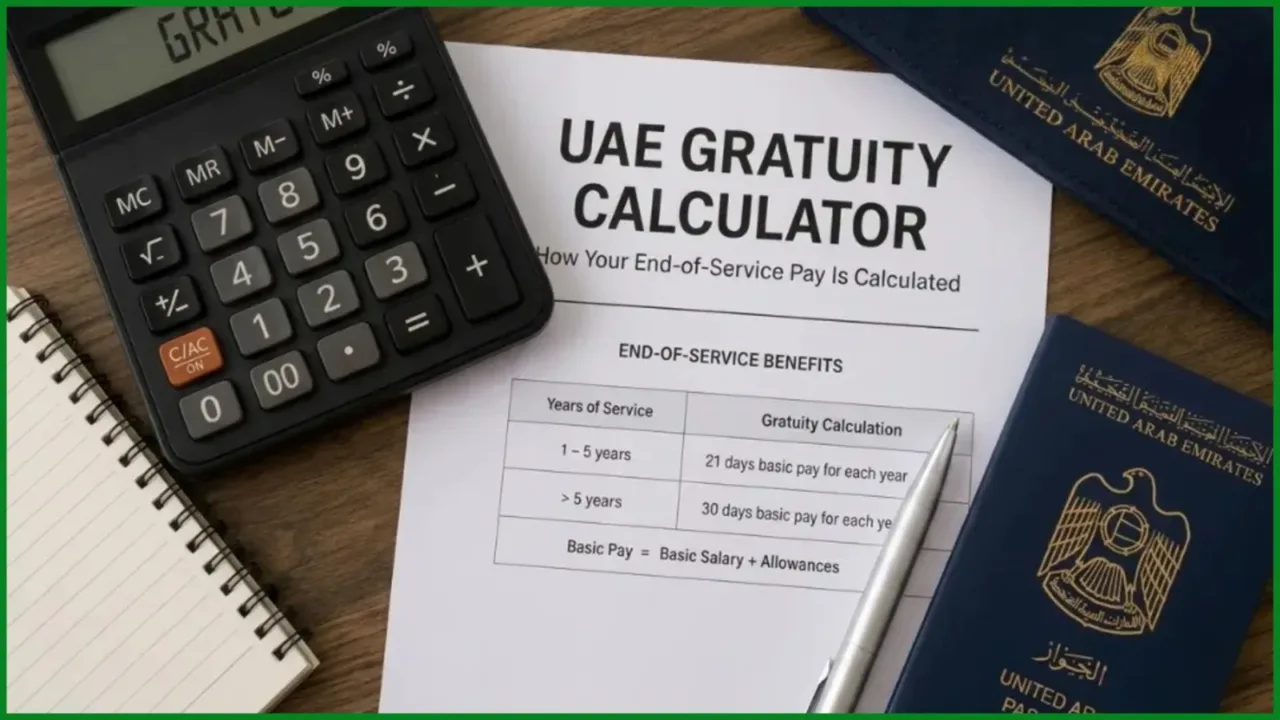
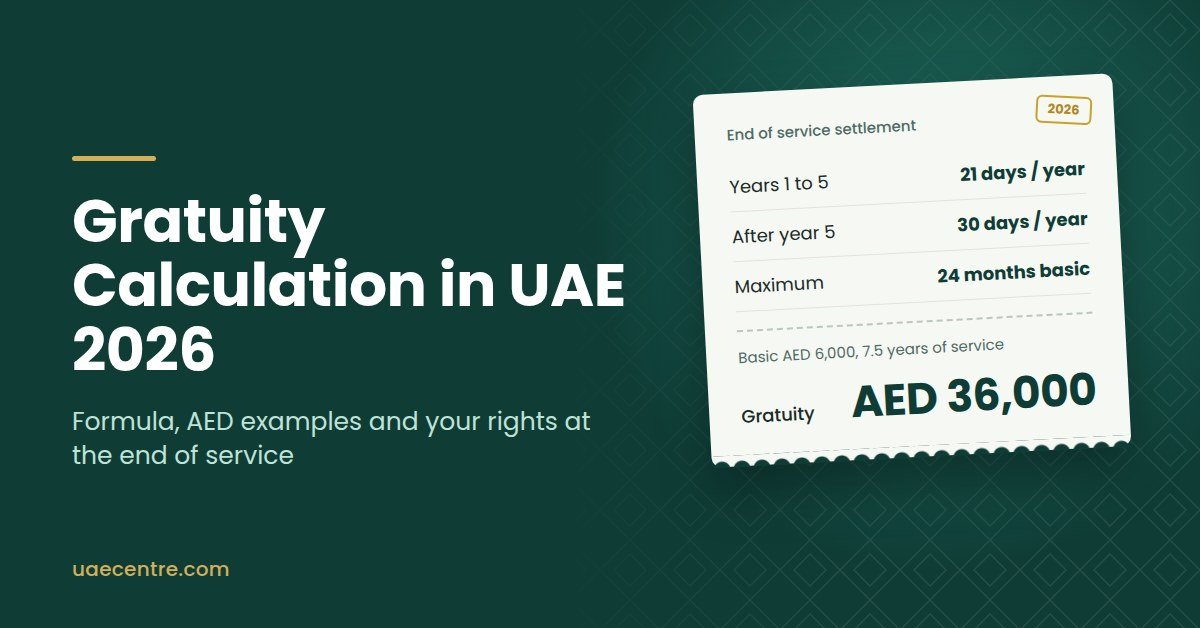
Quick answer: In the UAE private sector, you earn gratuity after one year of continuous service. You get 21 days of basic salary for each of your first five years, and 30 days of basic salary for every year after that. The total can never exceed two years of basic salary. Want a fast estimate? Try our free gratuity calculator.
What Is Gratuity in the UAE and Who Qualifies?
Gratuity, also called end of service benefits (EOSB), is a lump sum your employer pays when your employment ends. It rewards your years of service and gives you a financial cushion while you move to a new job or return home.
The rules come from Federal Decree-Law No. 33 of 2021 on the Regulation of Labour Relations, mainly Article 51. This law took effect on 2 February 2022 and replaced the old 1980 Labour Law. It applies to private sector employers across all seven emirates, including most free zones.
You qualify for gratuity if all of these are true:
- You are a full-time or part-time employee in the UAE private sector.
- You have completed at least one full year of continuous service with the same employer.
- You are not enrolled in an alternative scheme (such as DIFC’s DEWS or the MOHRE Savings Scheme) for that period of service.
The one-year rule is strict. If you leave on day 364, you receive no gratuity at all. If you are close to your first anniversary, it can be worth timing your exit carefully.
The reason you leave does not change your eligibility under the current law. Resignation, termination, contract expiry and retirement all qualify, as long as you meet the service requirement.
Basic Salary vs Total Salary: The Number That Decides Everything
Your gratuity is calculated on your last basic salary only, not your total monthly package. This is the single biggest source of confusion for UAE employees.
Most UAE salaries are split into a basic wage plus allowances. Housing, transport, phone, utilities and other allowances are not included in the gratuity calculation. Commissions and overtime are generally excluded too, unless your contract states otherwise.
Here is a typical example:
| Salary component | Monthly amount (AED) | Counts for gratuity? |
|---|---|---|
| Basic salary | 5,000 | Yes |
| Housing allowance | 2,500 | No |
| Transport allowance | 1,000 | No |
| Other allowances | 500 | No |
| Total package | 9,000 | Only 5,000 is used |
To find your correct basic salary, check your MOHRE-registered employment contract or your offer letter. You can also view your contract through the MOHRE app or website using your Emirates ID. Your payslip should show the same figure.
Tip: When negotiating a new job, pay attention to how your package is split. A higher basic salary means a higher gratuity, even if the total package is the same. And while job hunting, learn how to spot fake job offers that promise unrealistic packages.
How to Calculate Gratuity in UAE: The Exact Formula
The UAE gratuity formula works in days of basic salary, not percentages. Follow these four steps.
- Find your daily basic wage. Divide your monthly basic salary by 30. (Some employers divide annual basic by 365 instead; the difference is small, but ask HR which method they use.)
- Calculate your first five years. Multiply your daily wage by 21 days for each year of service, up to 5 years.
- Calculate years after five. Multiply your daily wage by 30 days for each year beyond the fifth.
- Apply the cap. Add both parts together. If the total is more than 24 months of basic salary, you receive 24 months of basic salary.
Gratuity formula: Gratuity = (Basic salary ÷ 30) × [(21 × years 1 to 5) + (30 × years after 5)], up to a maximum of 24 months of basic salary.
Partial years count. Once you pass the one-year mark, extra months and days are paid on a pro-rata basis. For example, 3 years and 6 months counts as 3.5 years.
Quick Reference Table (Basic Salary AED 5,000)
| Years of service | Gratuity days earned | Gratuity (AED) |
|---|---|---|
| Less than 1 year | 0 | 0 |
| 1 year | 21 | 3,500 |
| 2 years | 42 | 7,000 |
| 3 years | 63 | 10,500 |
| 5 years | 105 | 17,500 |
| 7 years | 165 | 27,500 |
| 10 years | 255 | 42,500 |
To use this table for a different salary, divide your basic salary by 5,000 and multiply the result by the gratuity shown.
Gratuity Calculation Examples in AED
The easiest way to understand the formula is to see it in action. Here are four common situations.
Example 1: Sales Executive, 3 Years of Service
Ahmed earns a basic salary of AED 4,000 (total package AED 7,000). He resigns after exactly 3 years.
- Daily wage: 4,000 ÷ 30 = AED 133.33
- Gratuity days: 21 × 3 = 63 days
- Gratuity: 133.33 × 63 = AED 8,400
Notice that his AED 3,000 in allowances plays no part in the calculation.
Example 2: Accountant, 1 Year and 8 Months
Priya earns a basic salary of AED 3,500. Her contract ends after 1 year and 8 months.
- Daily wage: 3,500 ÷ 30 = AED 116.67
- Service: 1 year + 8/12 = 1.667 years
- Gratuity days: 21 × 1.667 = 35 days
- Gratuity: 116.67 × 35 = AED 4,083
Because she passed the one-year mark, her extra eight months are paid too.
Example 3: Site Engineer, 7 Years and 6 Months
Rashid earns a basic salary of AED 6,000. He leaves after 7.5 years.
- Daily wage: 6,000 ÷ 30 = AED 200
- First 5 years: 21 × 5 = 105 days × 200 = AED 21,000
- Remaining 2.5 years: 30 × 2.5 = 75 days × 200 = AED 15,000
- Gratuity: 21,000 + 15,000 = AED 36,000
Example 4: Long-Serving Manager, 28 Years (the Cap Applies)
Maria earns a basic salary of AED 10,000 and retires after 28 years.
- Daily wage: 10,000 ÷ 30 = AED 333.33
- First 5 years: 105 days
- Remaining 23 years: 30 × 23 = 690 days
- Total: 795 days × 333.33 = AED 265,000
- Cap: 24 months × 10,000 = AED 240,000
- Gratuity paid: AED 240,000
The cap means that after about 25 and a half years with one employer, your gratuity stops growing unless your basic salary rises.
Gratuity on Resignation vs Termination: Old Rules vs New Rules
If you resign, you still get your full gratuity in 2026, provided you have completed one year and served your notice period properly. This is one of the most misunderstood facts about UAE labour law.
Under the old 1980 law, employees on unlimited contracts who resigned early lost part of their gratuity. Someone resigning after 1 to 3 years received only one third, and after 3 to 5 years only two thirds. Many websites and colleagues still quote these reductions.
Those reductions no longer apply. Since February 2022, all private sector contracts are fixed-term (limited) contracts, and companies had to convert their old unlimited contracts. The current law uses one formula for everyone, whatever the reason for leaving.
| Situation | Old law (before Feb 2022) | Current law (2026) |
|---|---|---|
| Resign after 1 to 3 years | One third of gratuity (unlimited contracts) | Full gratuity |
| Resign after 3 to 5 years | Two thirds of gratuity (unlimited contracts) | Full gratuity |
| Terminated by employer | Full gratuity | Full gratuity |
| Contract ends naturally | Full gratuity | Full gratuity |
| Less than 1 year of service | No gratuity | No gratuity |
What about dismissal for misconduct? Article 44 of the law allows an employer to dismiss an employee without notice for serious misconduct, such as fraud or a major safety breach. These cases are often disputed. If your employer refuses gratuity on misconduct grounds, do not accept it without question; contact MOHRE for guidance on your specific case.
Leaving without notice: If you walk out without serving your notice period, your employer can claim compensation equal to your wage for the notice period. This may be deducted from your final settlement, so always serve or properly negotiate your notice.
What Can Reduce or Affect Your Gratuity?
Even with the right formula, a few factors can change the final number on your settlement.
Unpaid leave and absences. Days of unpaid leave or unauthorised absence do not count toward your service period. If you worked 4 years but took 60 days of unpaid leave, your service is calculated as roughly 3 years and 10 months.
Money you owe the employer. Your employer may deduct amounts you legally owe, such as an outstanding salary advance or a company loan. These deductions should be clearly listed in your final settlement. Ask for a written breakdown if they are not.
Changes to your basic salary. Gratuity uses your last basic salary. If your basic increased over the years, you benefit. If your employer cut your basic and moved money into allowances, your gratuity drops. Any change to your contract terms should be agreed in writing and registered with MOHRE.
A new contract with the same employer. If your contract expires and you sign a new one without a break, for example during a UAE visa renewal, your service is generally treated as continuous. Some employers settle gratuity at each renewal instead. Either way, ask HR to confirm in writing how your earlier years are being handled.
Special Cases: Part-Time, Free Zones, DIFC, Savings Scheme and UAE Nationals
The standard formula covers most private sector workers, but some groups follow different rules.
| Who you are | How gratuity works |
|---|---|
| Part-time employee | Entitled to gratuity, calculated in proportion to the hours you actually work |
| Free zone employee (JAFZA, DMCC, DAFZA and others) | Generally the same federal formula as mainland companies |
| DIFC employee | Covered by the DEWS savings plan instead of a lump-sum gratuity; your employer pays monthly contributions |
| ADGM employee | Governed by ADGM’s own employment regulations; check your contract and HR policy |
| Enrolled in the MOHRE Savings Scheme | Gratuity earned before enrolment is calculated under the law; after enrolment, your benefits build up in an investment fund |
| UAE nationals | Usually covered by the national pension system (GPSSA or the emirate’s pension fund) rather than gratuity |
| Domestic workers | Covered by a separate domestic workers law with its own end of service rules |
The MOHRE Savings Scheme Explained
In late 2023, the UAE launched a voluntary alternative to traditional gratuity, often called the Savings Scheme. Instead of paying one lump sum at the end, participating employers make regular contributions into approved investment funds. Approved fund managers include First Abu Dhabi Bank, Lunate, Daman Investments and National Bonds.
The big advantage for employees is security. Your money sits in a regulated fund, so it is protected even if your employer later runs into financial trouble. Funds can also grow through investment returns. If your employer enrols you, the gratuity you already earned is calculated and settled under the standard law first, so you lose nothing from your past service.
When Must Gratuity Be Paid, and What If It Is Not?
Your employer must pay your gratuity and all other end of service dues within 14 days of your last working day. This includes unpaid salary, compensation for unused annual leave, and any other amounts owed under your contract.
If the 14 days pass and you have not been paid, follow these steps:
- Ask in writing first. Email HR with your calculation and request payment. Keep a copy. Many delays are resolved at this stage.
- File a complaint with MOHRE. Use the MOHRE app, the MOHRE website, or call 600 590000. You can also visit a Tas-heel or Tawjeeh service centre. You will need your Emirates ID, passport copy, contract and any evidence of what you are owed. Our step-by-step guide on how to file a MOHRE labour complaint walks you through it.
- Attend the amicable settlement. MOHRE will contact both sides and try to resolve the dispute. Most cases end here.
- Escalate if needed. MOHRE can issue binding decisions on claims up to AED 50,000. Larger or unresolved claims are referred to the labour court.
Do not wait too long. Labour claims generally have to be filed within two years of your employment ending. If you are leaving the UAE, file your complaint before you go, as it is much harder to follow up from abroad.
Watch your visa timing. After your visa is cancelled, you have a limited grace period to stay in the UAE. If a gratuity dispute is ongoing, plan your visa status around it. See our visa cancellation and grace period guide for current timelines.
7 Common Gratuity Mistakes UAE Employees Make
- Using total salary instead of basic salary. This makes people expect far more than they will receive, and leads to disappointment and disputes.
- Believing the old resignation cuts. The one-third and two-thirds reductions ended in 2022. If HR applies them, question it.
- Ignoring partial years. If you worked 4 years and 9 months, you are owed for 4.75 years, not 4.
- Forgetting the 21-to-30 jump. After year five, each year is worth almost 43% more. Leaving at 4 years 11 months versus 6 years makes a real difference.
- Leaving on day 364. One day short of a full year means zero gratuity.
- Signing the settlement without checking it. Once you sign a final settlement stating you have received all dues, it is harder to claim more. Check the math first.
- Leaving the UAE before resolving a dispute. File your MOHRE complaint while you are still in the country and reachable.
Before you sign anything, check: your basic salary figure, your exact start and end dates, any unpaid leave deducted, unused annual leave payout, and every deduction listed.