
Published: Sunday, 7 June 2026, at 3:19 pm| Dubai | Edited: Sunday, 7 June 2026, at 3:27 pm
The countdown has officially begun for football fans across the globe as North America prepares for the biggest sporting event in history. Let us dive into the ultimate FIFA World Cup 2026 guide to discover everything you need to know about this historic mega tournament.
FIFA World Cup 2026 Guide: The Ultimate Tournament Preview
The 2026 FIFA World Cup will be the 23rd edition of the quadrennial international men’s soccer championship. Contested by FIFA, this tournament will take place from June 11 to July 19, 2026.
It will be jointly hosted by sixteen cities across three North American nations. Eleven venues are located in the United States, three in Mexico, and two in Canada. This event marks the first time a World Cup will be hosted by three nations, making a comprehensive FIFA World Cup 2026 guide essential to track all the action. It is also the very first edition to include 48 teams, expanding from the traditional 32 team setup.
The Historic Multi Nation Bid
A look at how the United 2026 bid brought three massive countries together.
Hosting the grandest tournament on Earth requires immense infrastructure and planning. The joint North American bid brought three sports loving nations together to create an unforgettable event.
The United 2026 bid successfully beat a rival bid by Morocco during a final vote at the 68th FIFA Congress in Moscow. This tournament stands as the first men’s World Cup since 2002 to be co hosted by multiple nations.
- Historic Milestone for Mexico: Mexico is making history as the first country to host or co-host the men’s FIFA World Cup three times, following its successful hosting duties in 1970 and 1986.
- US Hosting History: The United States returns as a host nation after previously organizing the highly successful men’s tournament back in 1994.
- Canada’s Historic Debut: In contrast to its co-hosts, 2026 marks Canada’s very first time hosting or co-hosting the men’s World Cup.
Fans will also be happy to see the event return to its traditional Northern Hemisphere summer schedule. This comes after the 2022 World Cup in Qatar was uniquely held in November and December due to extreme weather conditions.
As the official host nations, Canada, Mexico, and the United States all received automatic qualification into the group stage. The expanded format has opened doors for new footballing nations to shine on the world stage. Cape Verde, Curaçao, Jordan, and Uzbekistan will all make their historic World Cup debuts during this edition.
New 48 Team Format Explained
Breakdown of the 48 team system and how it changes the tournament structure.
The expansion to 48 teams is the largest structural change the tournament has seen in decades. Understanding this setup is crucial, and our World Cup 2026 format guide makes it simple.
The idea of expanding the tournament had been suggested as early as 2013 by then UEFA president Michel Platini, and also in 2016 by FIFA president Gianni Infantino. However, the proposal faced significant criticism from different football bodies.
Opponents of the proposal argued that the number of matches played was already at an unacceptable level for player health. Others believed that the expansion would dilute the overall quality of the matches in the group stages. Some critics went as far as accusing Infantino of using the promise of bringing more countries to the World Cup simply to win his presidential election.
Despite the debates, the FIFA Council officially approved the expansion. Starting with this edition, the FIFA World Cup expanded to 48 teams, an increase of 16 teams compared to the previous seven tournaments. This represents the first major expansion and tournament format change since the 1998 World Cup in France.
The teams will be split into twelve groups of four teams each. The top two teams in each group, alongside the eight best third placed teams, will progress to a brand new round of 32.
Because of this system, the total number of matches played in the tournament will increase dramatically from 64 to 104. The number of matches played by teams reaching the final four will also increase from seven to eight.
Official Group Stage Draws
The full listing of the 12 groups competing in the opening stage.
The group stage forms the foundation of the entire tournament journey. Let us look at how the 48 teams are distributed across the twelve competitive groups from A to L.
The group stage will be played across North America from June 11 to 27. Competing countries are divided into twelve groups of four teams. In the group standings, three points are awarded for a win, one point for a draw, and zero points for a loss.
- Group A: Mexico (H), South Africa, South Korea, Czech Republic
- Group B: Canada (H), Bosnia and Herzegovina, Qatar, Switzerland
- Group C: Brazil, Morocco, Haiti, Scotland
- Group D: United States (H), Paraguay, Australia, Turkey
- Group E: Germany, Curaçao, Ivory Coast, Ecuador
- Group F: Netherlands, Japan, Sweden, Tunisia
- Group G: Belgium, Egypt, Iran, New Zealand
- Group H: Spain, Cape Verde, Saudi Arabia, Uruguay
- Group I: France, Senegal, Iraq, Norway
- Group J: Argentina, Algeria, Austria, Jordan
- Group K: Portugal, DR Congo, Uzbekistan, Colombia
- Group L: England, Croatia, Ghana, Panama
The Intense Knockout Stage
The high stakes, single elimination tournament path to the final.
Once the group stage concludes, the tournament transforms into a high intensity survival battle. Every single match becomes a must win scenario for the teams.
The knockout stage will be played in a single elimination format. It starts with the historic new round of 32 on June 28 and culminates with the grand final on July 19. On the day prior to the final, a match for third place will be played between the two losing teams of the semi finals to determine the bronze medalists.
In the knockout stage, if the scores are level when normal playing time expires, 30 minutes of extra time will be played. If the teams remain tied at the end of extra time, a penalty shootout will be used to determine the winner.
Host Cities and Iconic Venues
A detailed overview of the selected North American cities and stadiums.
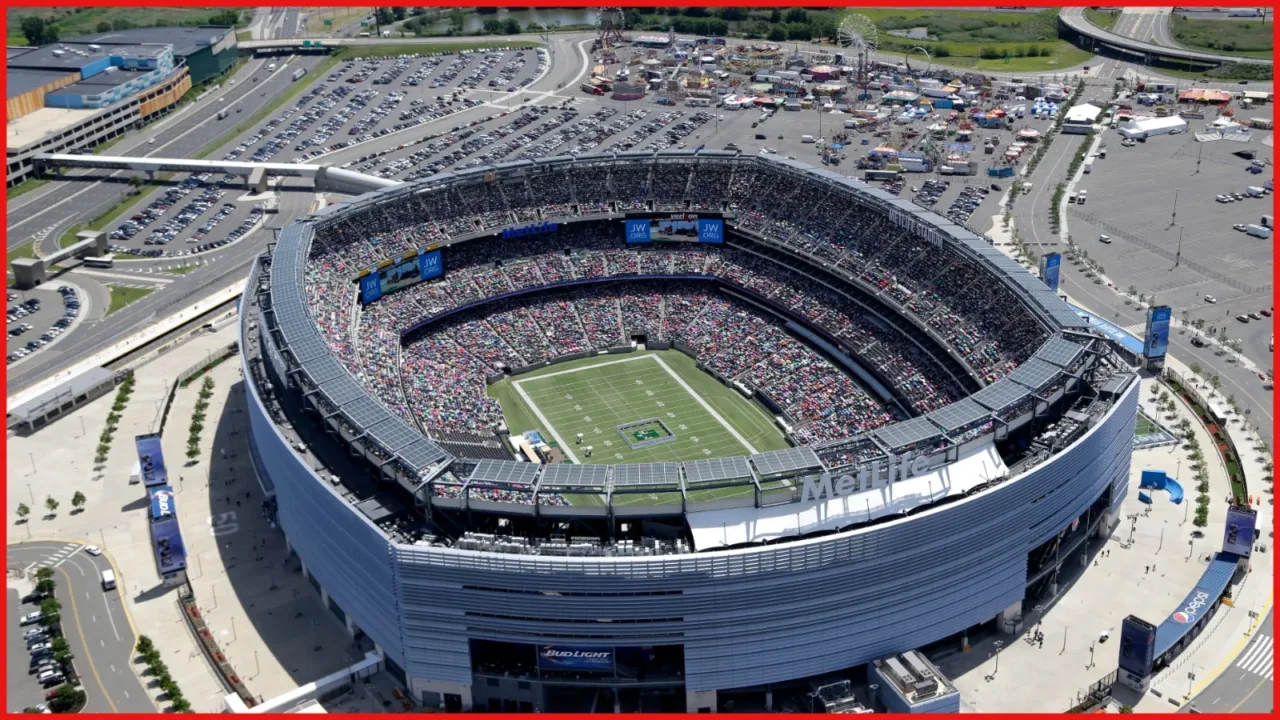
The venues chosen for this competition represent some of the most advanced sports stadiums in the world.
During the bidding process, 41 cities with 42 existing, fully functional venues submitted proposals to be part of the bid. A first round elimination cut nine venues and nine cities. A second round elimination cut an additional nine venues in six cities. Three cities (Chicago, Minneapolis, and Vancouver) initially dropped out due to financial disagreements with FIFA. Montreal also dropped out in July 2021 due to a lack of provincial funding to renovate the Olympic Stadium. However, Vancouver rejoined the bid as a candidate city in April 2022, bringing the total number to 24 candidate venues.
On June 16, 2022, the final sixteen host cities were announced by FIFA. Eight of the chosen stadiums have permanent artificial turf surfaces. These are planned to be replaced with natural grass under the direction of FIFA and an expert research team from the University of Tennessee and Michigan State University. Depending on the venue’s climate, the turf used will be a hybrid of 84% Kentucky bluegrass and 16% perennial ryegrass for cooler temperatures, or Bermuda grass for warmer temperatures.
Four venues (Atlanta, Dallas, Houston, and Vancouver) are indoor stadiums that use retractable roof systems with full climate control. A fifth stadium in Los Angeles is open air but features a translucent roof without climate control. The host of the final match will be MetLife Stadium in East Rutherford.
| City | Stadium | Alternative FIFA Name | Capacity |
| Atlanta, USA | Mercedes-Benz Stadium | Atlanta Stadium | 75,000 |
| Boston, USA | Gillette Stadium | Boston Stadium | 65,000 |
| Dallas, USA | AT&T Stadium | Dallas Stadium | 94,000 |
| Guadalajara, Mexico | Estadio Akron | Estadio Guadalajara | 48,000 |
| Houston, USA | NRG Stadium | Houston Stadium | 72,000 |
| Kansas City, USA | Arrowhead Stadium | Kansas City Stadium | 73,000 |
| Los Angeles, USA | SoFi Stadium | Los Angeles Stadium | 70,000 |
| Mexico City, Mexico | Estadio Azteca | Mexico City Stadium | 83,000 |
| Miami, USA | Hard Rock Stadium | Miami Stadium | 65,000 |
| Monterrey, Mexico | Estadio BBVA | Estadio Monterrey | 53,500 |
| New York/New Jersey, USA | MetLife Stadium | NY NJ Stadium | 82,500 |
| Philadelphia, USA | Lincoln Financial Field | Philadelphia Stadium | 69,000 |
| San Francisco, USA | Levi’s Stadium | SF Bay Area Stadium | 71,000 |
| Seattle, USA | Lumen Field | Seattle Stadium | 69,000 |
| Toronto, Canada | BMO Field | Toronto Stadium | 45,000 |
| Vancouver, Canada | BC Place | BC Place Vancouver | 54,000 |
Record Breaking Prize Money Distribution
Breakdown of the financial rewards for the participating national teams.

With increased matches and revenue comes a much larger prize pool for the participating nations. FIFA has committed to a record breaking financial distribution for this edition.
In April 2026, FIFA confirmed the official prizes for all participating nations. This edition’s total performance based distribution for the tournament will be a massive $871 million. This is $431 million higher than the prize pool of the previous tournament in 2022.
In addition to the performance based prize money, each qualified team will also receive a $10 million qualification payment. They will also receive a $2.5 million preparation fee before the competition starts to help manage travel and training costs.
- Champions: $50 million (1 team)
- Runners-up: $33 million (1 team)
- Third place: $29 million (1 team)
- Fourth place: $27 million (1 team)
- 5th–8th place (Quarter-finals): $19 million per team
- 9th–16th place (Round of 16): $15 million per team
- 17th–32nd place (Round of 32): $11 million per team
- 33rd–48th place (Group stage): $9 million per team
This financial structure ensures that even teams exiting in the initial group stage receive substantial financial support to develop football in their home countries.
Conclusion
The 2026 edition promises to be a historic celebration of global football. Stay tuned as we update our FIFA World Cup 2026 guide with breaking news, team updates, and match results.
FAQ
How does the new 48 team format work?
The 48 teams are divided into 12 groups of four. The top two teams from each group, along with the eight best third-placed teams, advance to a new knockout round of 32.
Which stadium will host the 2026 World Cup Final?
MetLife Stadium, located in East Rutherford, New Jersey (referred to as the New York New Jersey Stadium for the tournament), will host the final match on July 19, 2026.
How much prize money does the winning team receive?
The tournament champions will receive $50 million in performance-based prize money, in addition to their $10 million qualification payment and $2.5 million preparation fee.
Are there any new countries making their debut in 2026?
Yes, four countries will be making their official FIFA World Cup debuts in this edition, Cape Verde, Curaçao, Jordan, and Uzbekistan.
ALSO READ: FIFA 2026 World Cup Ticket Controversy; Fan Outrage Over Email Blunders and Latest Price Updates



2 thoughts on “The Biggest Sports Event on Earth is Coming: Complete FIFA World Cup 2026 Guide to Groups, Venues, and Prize Money”