It’s the first week of the month. Your salary has landed, and before anything else, you open the app or head to the exchange house to send money home. For your parents’ medicines, your child’s school fees, the house you’re slowly building back home.
For millions of expats in the UAE, this is a monthly ritual. But here’s something many people never realise: two transfers of the same amount, sent on the same day, can deliver very different amounts to your family, sometimes enough to pay a utility bill back home. The difference isn’t always in the fee you see. It’s hidden in the exchange rate.
This guide breaks down the main ways to send money from the UAE in 2026, how to compare them properly, and the mistakes that quietly cost expats hundreds of dirhams a year.
Quick answer: You can send money from the UAE through banks, exchange houses (in branches or their apps), digital remittance apps and mobile wallets. To find the cheapest option, compare the total amount your family receives, not just the fee, because exchange rate margins are often the biggest cost. Only use providers licensed by the Central Bank of the UAE (CBUAE), and keep a valid Emirates ID, as you’ll need it for every transfer.
Your Main Options for Sending Money Home
| Method | Best for | Things to know |
|---|---|---|
| Exchange house branch | Cash payments, people who prefer face-to-face help | Familiar and widely available, but branch fees are usually higher than in-app transfers |
| Exchange house app | Regular monthly transfers to South Asia, the Philippines and Africa | Often cheaper than the branch, with the option of in-person help if something goes wrong |
| Digital remittance apps | Comparing rates, sending from a debit card or bank account | Can offer competitive rates, but check they’re licensed in the UAE |
| Bank transfer (SWIFT) | Large amounts, sending to your own account abroad | Convenient, but fees plus exchange rate margins can add up |
| Mobile wallets | People without a bank account | Some wallets let you hold money, pay bills and send abroad without a bank account |
Popular names you’ll come across include exchange houses such as Al Ansari Exchange and Lulu Exchange (and their apps), wallet services such as Payit and e& money, and international apps such as Wise and Remitly. Every provider has its strong corridors, so the cheapest for India may not be the cheapest for the Philippines.
The Hidden Cost Most People Miss: The Exchange Rate
Every transfer has two costs:
- The transfer fee you can see, such as AED 15 or AED 25.
- The exchange rate margin, the difference between the real market rate and the rate you’re given. This one is often hidden inside the rate itself.
Banks commonly add a margin of around 1.5% to 3% on international wires, while exchange houses and apps are often lower, though it varies by provider and country. On a single transfer that sounds small. Over a year, it isn’t.
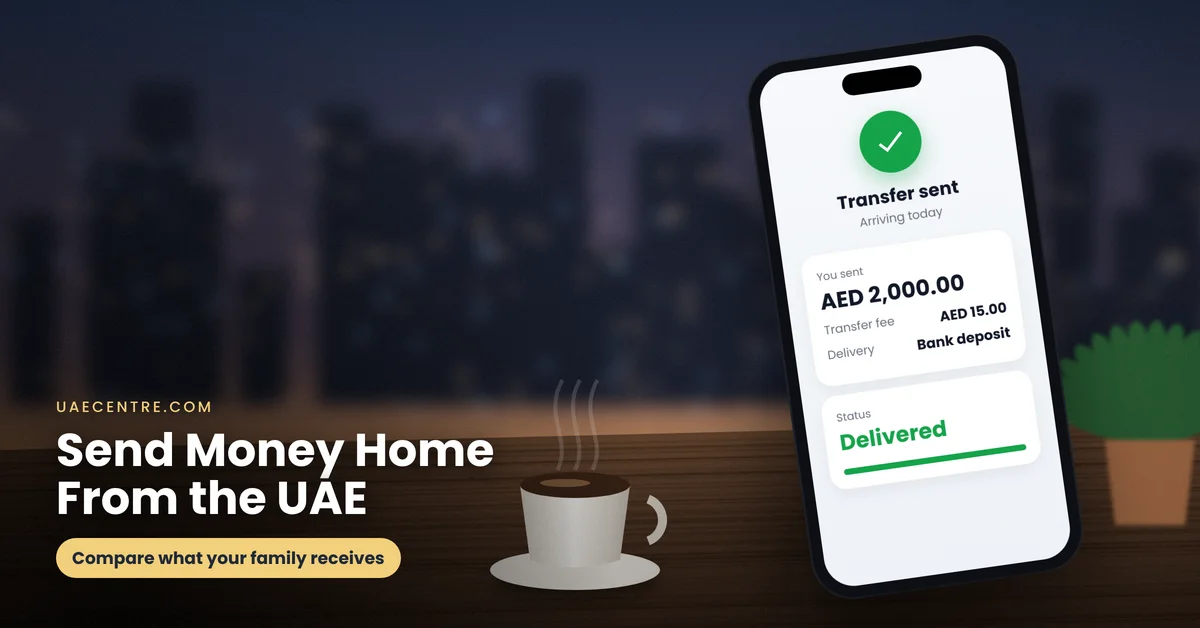
Example: You send AED 2,000 home. Provider A charges no fee but gives a rate 1.5% below the market rate, so you lose about AED 30 in the rate. Provider B charges an AED 20 fee but gives a rate only 0.5% below the market rate, losing about AED 10. Provider B costs about AED 30 in total, the same as A. On AED 5,000, Provider B is clearly cheaper. The “free” option isn’t always the cheapest.
The simple rule: always compare the final amount your family will receive, in their currency, for the same amount sent. Most apps show this before you confirm. The World Bank’s Remittance Prices Worldwide database is also a useful way to see typical costs for your corridor.
How to Find the Cheapest Way Each Month
- Pick two or three trusted providers for your country, such as one exchange house app, one digital app and your bank.
- Enter the same amount in each and note how much the recipient will get.
- Check the speed and delivery method. Bank deposit, cash pickup and mobile wallet can be priced differently.
- Look at promotions carefully. “First transfer free” deals often apply once only.
- Repeat every few months. Rates and fees change, and loyalty doesn’t always pay.
It takes five minutes, and for many families, it adds up to a meaningful amount over a year.
Does the Day You Send Money Matter?
Exchange rates move every day, and many people try to time their transfers for the “best” rate. In reality, nobody can predict short-term currency moves reliably, so don’t hold back money your family needs while waiting for a better rate.
What does help is avoiding the busiest times. In the first few days after salaries are paid, and before big festivals, branches get crowded and some providers adjust promotions. If your timing is flexible, sending a few days earlier or later can mean shorter queues and, occasionally, better offers. Some apps also let you set a rate alert, so you’re notified when the rate reaches a level you’re happy with.
Branch or App: Which Is Better?
Many workers still prefer the exchange house branch. It feels safer to hand over cash and get a receipt from a person. That’s completely understandable, and branches remain a reliable option.
But apps usually work out cheaper, and they save the Friday queue. Most exchange houses now let you register in their app using your Emirates ID, verify your face, and send money from your debit card or salary card any time of day. If you’re nervous about switching, try a small transfer first, then compare what your family receives.
Sending Money Without a Bank Account
Not everyone in the UAE has a bank account, especially domestic workers, new arrivals, and employees whose salary is below a bank’s minimum salary requirement. You still have good options:
- Exchange house branches accept cash for transfers.
- Salary cards issued through WPS can often be used to fund transfers in apps, though the card issuer may charge its own fee.
- Mobile wallets such as Payit (which doesn’t require a bank account with its operator) and e& money let you load money, pay bills and send abroad.
Whatever you choose, register using your own Emirates ID, never someone else’s.
Documents and Limits: What You’ll Need
- A valid Emirates ID. Transfers are tied to your identity, so an expired ID can stop you from sending. Keep your valid Emirates ID up to date.
- Your recipient’s details: full name as on their ID, bank account or IBAN, bank name, or mobile wallet number.
- Proof of source of funds for large amounts. For bigger transfers (single transfers around AED 55,000 or more often trigger questions), you may be asked for a salary certificate, payslips or bank statements. This is a normal anti-money-laundering check, not an accusation.
Regular transfers that don’t match your income can also trigger questions, so keep your payslips handy if you send larger amounts.
How Much Should You Send? A Simple Budget Check
Many expats send so much home that they struggle by the end of the month in the UAE. A little planning protects both you and your family. Before your salary arrives, write down your fixed UAE costs (rent, transport, food, phone and any loan payments), keep a small emergency buffer of your own, and then decide how much to send.
If you can, agree a regular monthly amount with your family rather than sending whatever is left over. It makes their budgeting easier, and it helps you avoid the cycle of borrowing at the end of the month. Even a small personal savings amount kept in the UAE can save you when something unexpected happens, such as a medical bill, a job change or a delayed salary.
Country-Specific Tips
India
Bank deposits and UPI-linked accounts are common receiving methods. Many Indians in the UAE also use NRE accounts for savings. Compare rates around festivals like Diwali, when many people send extra money and some providers run promotions.
Pakistan
Bank deposits are popular, and mobile wallets such as JazzCash and Easypaisa are widely used for fast delivery. Always send through official channels. Informal hundi or hawala arrangements are risky and illegal when unlicensed.
Philippines
Cash pickup, bank deposit and e-wallets such as GCash are all common. Check whether your recipient prefers cash or digital, since pricing can differ.
Bangladesh, Nepal and Sri Lanka
Exchange house apps and branches have strong coverage, and mobile wallets like bKash are popular in Bangladesh. Compare the delivered amount, as corridor pricing varies a lot.
Costly Mistakes to Avoid
- Using unlicensed agents. Never send money through a stranger’s personal account, a WhatsApp “agent” or an unlicensed hawala. You have no protection if the money disappears, and it can create legal problems.
- Only looking at the fee. A zero-fee transfer with a poor rate can cost more than a small-fee transfer with a good rate.
- Typing errors. A wrong IBAN or name can delay or lose a transfer. Save trusted recipients in your app and double-check new ones.
- Sending under pressure. Scammers pose as relatives, employers or officials demanding urgent transfers. Verify by phone before sending.
- Ignoring your receipts. Keep the transaction reference until the money arrives, in case you need to trace it.
And if the problem is that your salary isn’t being paid on time in the first place, you can file a MOHRE complaint for free.
Is It Safe to Use Apps?
Yes, as long as you use licensed providers and protect your account. Check that the provider is licensed by the Central Bank of the UAE, download apps only from the official App Store or Google Play, turn on biometric login, and never share your one-time passwords (OTPs) with anyone, even someone claiming to be from the company.
Make Every Dirham Count
You work hard for every dirham you send home. Spending five minutes comparing providers, using licensed channels and checking what your family actually receives makes sure more of that money arrives where it’s needed. Small habits, repeated every month, add up to real savings over a year.
Useful sources: Central Bank of the UAE and the World Bank’s Remittance Prices Worldwide.
This guide is for general information and is not financial advice. Fees, exchange rates and provider rules change frequently, so always check the final amount and terms before sending. Last updated: 16 October 2026.