If you have a personal loan in the UAE, your phone has probably been busy lately. Calls, SMS and emails from banks, all saying the same thing: “Transfer your loan to us. Lower rate. Cash back. Skip your first instalment.”
There’s a reason for the sudden rush. UAE banks are reportedly preparing new rules on loan transfers from January 2027. And banks are competing hard to win customers before they arrive.
Here’s what’s proposed, what the rules are today, and how to work out whether switching really saves you money.
Quick answer: UAE banks are reportedly moving towards new rules from 1 January 2027 that would require borrowers to stay with their original lender for a set period and pay a minimum number of instalments before transferring a loan. The details are not yet officially confirmed. Today, you can transfer a personal loan to another UAE bank by paying an early settlement fee of up to 1% of the outstanding amount or AED 10,000, whichever is less. Only switch if the total savings are bigger than all the fees.
What’s Being Proposed for 2027?
According to a banking source quoted in the UAE press, the new rules would:
- Require borrowers to stay with the bank that gave them the loan for a minimum period before switching
- Require a minimum number of instalments to be paid before the debt can be moved
- Possibly apply differently to different types of financing and borrowers
The aim is to reduce the practice of repeatedly closing and refinancing loans over short periods, which adds paperwork and costs, and to help banks plan their lending and manage risk.
Not final yet: the waiting period, the number of instalments and the start date have not been officially confirmed. Treat any “deadline” in a sales call with caution until the rules are published.
What Are the Rules Today?
Under the Central Bank’s current regulations, you’re allowed to move your personal loan to another bank or finance company in the UAE. Here are the key points:
| Rule | What it means |
| Early settlement fee | Up to 1% of the outstanding loan, or AED 10,000, whichever is less |
| Maximum personal loan | Up to 20 times your monthly salary or income |
| Maximum repayment period | Usually 48 months for personal loans |
| New bank’s conditions | It must follow the rules on loan amount, repayment period and monthly instalments |
You can read the regulations in the Central Bank rulebook.
Flat Rate vs Reducing Rate: The Trap to Avoid
Before comparing offers, you need to understand this. UAE banks advertise loans in two ways:
- A flat rate is charged on the full original loan for the whole term, even as you pay it down.
- A reducing rate is charged only on what you still owe, so interest falls as you repay.
A flat rate always looks lower than a reducing rate, but it isn’t cheaper. For example, a 5% flat rate on a four-year loan costs about the same as a reducing rate of around 9.2%.
So when comparing offers, always ask for the reducing rate (sometimes called the annual percentage rate). That’s the only fair way to compare.
Does a Loan Transfer Save You Money? A Simple Example
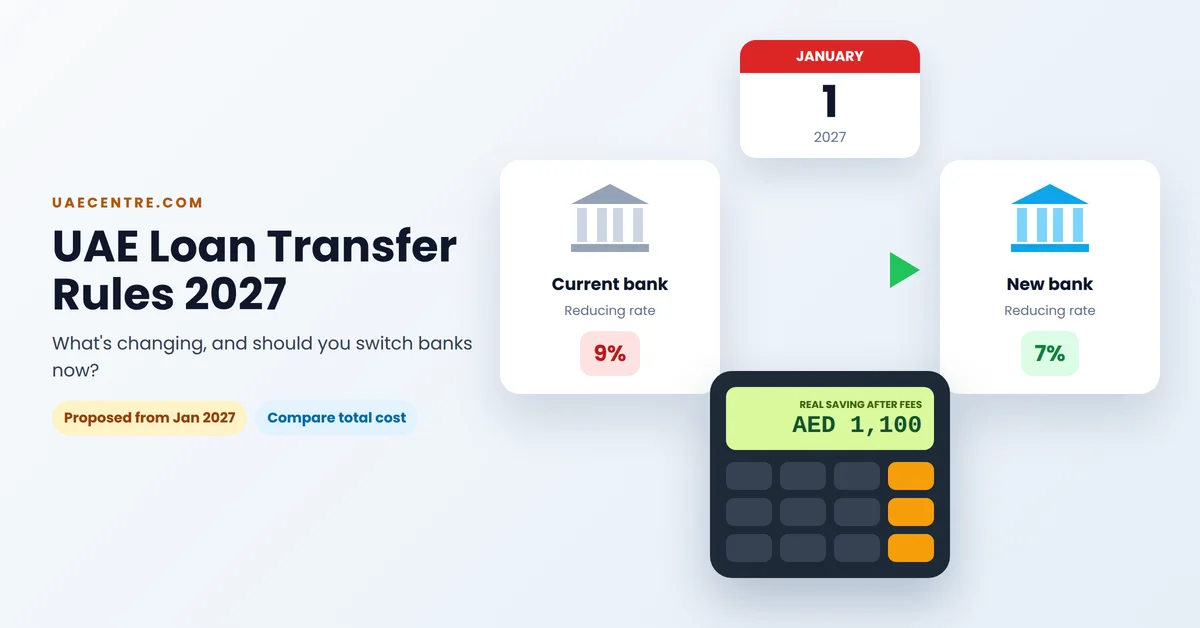
Example: you owe AED 80,000 with 36 months left at a reducing rate of 9%. Your monthly payment is about AED 2,544. A new bank offers 7% for the same 36 months. Your new payment would be about AED 2,470, saving around AED 74 a month, or roughly AED 2,650 over three years. But then take off the costs: an early settlement fee of up to 1% (AED 800), plus any processing fee and insurance at the new bank. If those add up to around AED 1,500, your real saving is closer to AED 1,100. Still worth it, but much less than the ad suggests.
The lesson? Look at the total cost, not just the monthly payment.
Watch Out for These Offer Tricks
- “Skip your first instalment.” Sounds great, but interest usually keeps building. You may pay more overall.
- Cash back. Nice, but check whether it’s bigger than the fees you’ll pay to switch.
- Longer repayment periods. Lower monthly payments can mean much more interest in total.
- Top-up loans. Borrowing extra when you switch makes your debt bigger. Only do it if you really need it.
- Hidden fees. Ask about processing fees, life insurance, and any fees for paying off early later.
- Salary transfer. Many of the best rates require you to move your salary to the new bank. Check what that means for your accounts and cards.
Should You Transfer Your Loan Before 2027?
It depends on your numbers, not on the deadline. Consider switching if:
- The new reducing rate is clearly lower than your current one
- Your total savings, after every fee, are meaningful to you
- You’re not being pushed into borrowing more
Think twice if your loan is almost paid off, since savings will be small, or if the offer depends on deferred payments or a longer term.
Bottom line: don’t switch just because a salesperson says “rules are changing”. Switch only if the numbers work. If the proposed rules are confirmed, you’ll still be able to transfer later, you’ll just need to meet the new waiting period first.
How to Transfer a Loan, Step by Step
- Get a liability letter from your current bank showing exactly what you owe.
- Collect quotes from two or three banks. Ask each for the reducing rate, all fees and the total cost.
- Compare the total cost of staying versus switching.
- Apply with your chosen bank. You’ll usually need your Emirates ID, passport, salary certificate and bank statements.
- The new bank pays off your old loan, usually by manager’s cheque or transfer.
- Get a clearance letter from your old bank, and check your credit report later to make sure the old loan shows as closed.
Many banks now let you start applications online and log in with UAE Pass, which can make the process faster.
Protect Yourself From Loan Scams
Busy loan seasons bring scammers. Be careful with anyone who asks for an upfront “processing fee” to approve a loan, asks for your OTP, or contacts you from a personal mobile number claiming to be a bank. Only deal with licensed banks and finance companies, through their official branches, apps or websites. Our guide to scams in the UAE explains the warning signs.
Think About Your Budget First
A loan transfer can lower your monthly payment, but it doesn’t remove the debt. Before taking on any loan, check that the repayments fit your budget, especially with other rising costs like fuel this year. Our guide to the UAE minimum salary also explains how income rules affect what you can borrow and who you can sponsor.
Frequently Asked Questions
Final Word: Let the Numbers Decide
The proposed rules may make loan transfers less flexible from 2027, and banks know it, which is why the offers are flying. Take your time. Ask for the reducing rate, add up every fee, and compare the total cost. If switching clearly saves you money, go ahead. If it doesn’t, the best deal might be the loan you already have.
Official sources: Central Bank of the UAE and the Central Bank rulebook.
This article is for general information and is not financial advice. The 2027 rules are based on reports and may change once officially confirmed. Speak to your bank or a licensed adviser about your situation. Last updated: 3 November 2026.