“Is AED 10,000 a month enough to live in Dubai?” It’s one of the most common questions people ask before taking a job here. And the honest answer is: it depends.
It depends on where you live, whether you share, whether you drive, and above all, whether you have children in school. Two people on the same salary can have completely different lives.
This guide breaks down the real costs of living in Dubai in 2026, line by line, with sample budgets for a single person, a couple and a family. Then it shows where you can save.
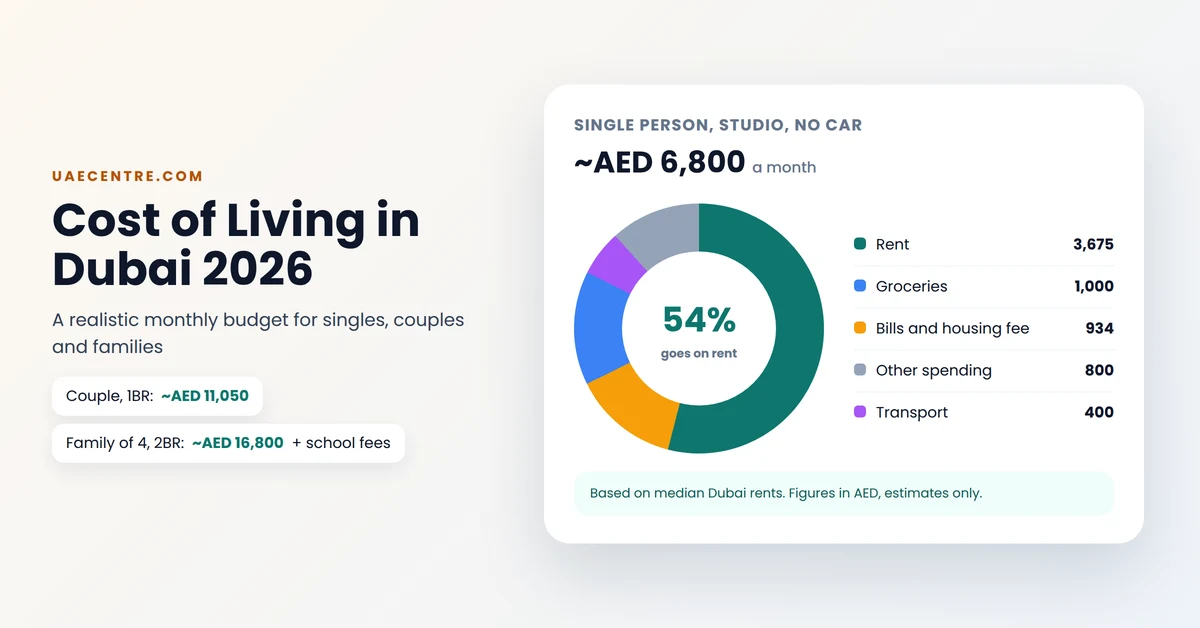
Quick answer: Rent is the biggest cost. Based on Dubai Land Department data, the median annual rent is about AED 44,100 for a studio, AED 68,000 for a one-bedroom, AED 103,000 for a two-bedroom and AED 180,000 for a three-bedroom. Excluding rent, Numbeo estimates monthly costs of about AED 4,172 for a single person and AED 14,678 for a family of four. In our sample budgets, a single person renting a studio needs around AED 6,800 a month, a couple around AED 11,000, and a family of four around AED 16,800 before school fees.
Rent: Your Biggest Expense
Rent usually takes 30% to 40% of a monthly budget. Here are median rents across Dubai, based on registered tenancy contracts:
| Home size | Median annual rent | Monthly equivalent |
| Studio | AED 44,100 | About AED 3,675 |
| 1 bedroom | AED 68,000 | About AED 5,667 |
| 2 bedrooms | AED 103,000 | About AED 8,583 |
| 3 bedrooms | AED 180,000 | About AED 15,000 |
These are city-wide medians. Prime areas like Downtown and Dubai Marina cost much more, while areas like International City, Jumeirah Village Circle (JVC) and Discovery Gardens are usually cheaper.
Many people also share. Splitting a one-bedroom between two people works out much cheaper per person than renting a studio alone. If you share, make sure your home follows Dubai’s shared housing rules, and keep a written agreement with your flatmates.
Don’t forget the housing fee: tenants in Dubai pay a Dubai Municipality housing fee of 5% of annual rent, added to the DEWA bill. On a AED 68,000 rent, that’s about AED 283 a month.
Monthly Bills: What to Expect
| Bill | Typical monthly cost (AED) | Notes |
| DEWA (electricity and water) | 300 to 1,000+ | Much higher in summer; read our DEWA guide |
| Housing fee | 5% of rent ÷ 12 | Paid through DEWA |
| Internet and mobile | 350 to 600 | Depends on plan and family size |
| District cooling (some buildings) | 200 to 800+ | Billed separately in some towers |
Your DEWA bill is the one you can control most. Setting the AC to 24°C and staying under 2,000 kWh a month makes a real difference.
Getting Around
Transport costs depend heavily on whether you drive:
- Metro, bus and tram: often AED 300 to 500 a month for a regular commuter. A digital nol QR ticket helps for occasional trips.
- Driving: with petrol prices above AED 4 a litre this autumn, fuel alone can cost AED 600 to 1,000 a month for a daily commute. Add car insurance, servicing, parking and Salik tolls.
- Taxis and ride-hailing: convenient, but daily use adds up fast.
Food and Groceries
Groceries for one person usually cost around AED 800 to 1,500 a month, and for a family of four AED 2,500 to 4,000, depending on brands and where you shop. Eating out ranges from cheap cafeterias to very expensive restaurants, so it’s the easiest place to cut back.
Health Insurance
Your employer must pay for your basic health insurance. But in Dubai, insuring your spouse and children is usually your cost, unless your employer covers families. Get quotes before your family moves, as prices vary a lot by age and plan.
School Fees: The Family Budget Breaker
For families, school fees can be as big as rent. Private school fees in Dubai range from around AED 20,000 to well over AED 60,000 a year per child, depending on the school and curriculum. Add uniforms, books, transport and activities.
If your employer offers an education allowance, factor it in. If not, choose your school and home together, since living near school cuts transport costs and time.
Sample Monthly Budgets for 2026
These are our own estimates, using median rents and typical costs. Your real numbers will differ, but they’re a useful starting point.
| Monthly cost (AED) | Single (studio, no car) | Couple (1BR, one car) | Family of 4 (2BR, one car) |
| Rent | 3,675 | 5,667 | 8,583 |
| Housing fee | 184 | 283 | 429 |
| DEWA | 350 | 500 | 900 |
| Internet and mobile | 400 | 500 | 600 |
| Groceries | 1,000 | 1,600 | 2,800 |
| Transport | 400 | 1,300 | 1,500 |
| Family health insurance | Employer | Varies | About 500 |
| Other spending | 800 | 1,200 | 1,500 |
| Total (before school fees) | About 6,800 | About 11,050 | About 16,800 |
For the family, add school fees on top. Two children at mid-range schools could add AED 4,000 to 8,000 or more a month.
Remember to leave room for savings, and for any money you send home to family. A budget with no savings line is fragile.
How Much Salary Do You Need?
Based on the budgets above, a single person can live modestly on around AED 7,000 to 8,000 a month in a shared or budget home, but AED 10,000 or more gives more comfort and room to save. Couples typically need AED 12,000 to 15,000. Families with school-age children often need AED 25,000 or more, unless housing or schooling is covered by the employer.
Also check the official income rules for sponsoring family. Our minimum salary guide explains the thresholds.
10 Ways to Lower Your Cost of Living
- Live a little further out. Rents drop sharply outside prime areas.
- Share legally. Splitting a larger flat can save thousands a year.
- Pay rent in fewer cheques. Some landlords offer a discount for one or two cheques.
- Use public transport for regular trips.
- Cut your DEWA bill with smarter AC use.
- Cook more, eat out less.
- Compare health insurance and phone plans every year.
- Avoid high-interest debt. Think carefully before taking or transferring a loan.
- Know your tenant rights. If a landlord raises rent unfairly, our rental dispute guide can help.
- Track spending monthly. Small leaks add up.
Frequently Asked Questions:
Final Word: Know Your Numbers First
Dubai can be as affordable or as expensive as you make it. Before you move, sign a lease or accept a job offer, write down your likely rent, bills, transport and school costs, and compare them with your take-home pay. Leave room for savings. With a clear budget, you can enjoy everything the city offers without money stress.
Data sources: Dubai Land Department rental data and Numbeo.
This guide is for general information. Prices change often, and your costs depend on your area, lifestyle and family. Budgets shown are estimates. Last updated: 8 November 2026.