Think about your longest day behind the wheel. A school run, a full day of client visits, a late drive home. Or maybe driving is your job, and 12-hour shifts are normal.
From 1 January 2027, that may have to change. New UAE traffic rules start that day. They cover how long you can drive and how many cars you can own. They also change how long your licence lasts, and who can ride an e-scooter.
Here’s what’s changing, explained by who you are, and what you can do now to be ready.
Quick answer: From 1 January 2027, under Cabinet Decision No. 174 of 2026, UAE drivers must not drive more than nine hours in any 24-hour period, or drive when too tired to do so safely. Residents can own two vehicles as standard and up to five with an extra fee for each additional car. Licence validity changes by age and nationality, eligible newer cars can get two-year registration, and e-scooter permits start from age 15.
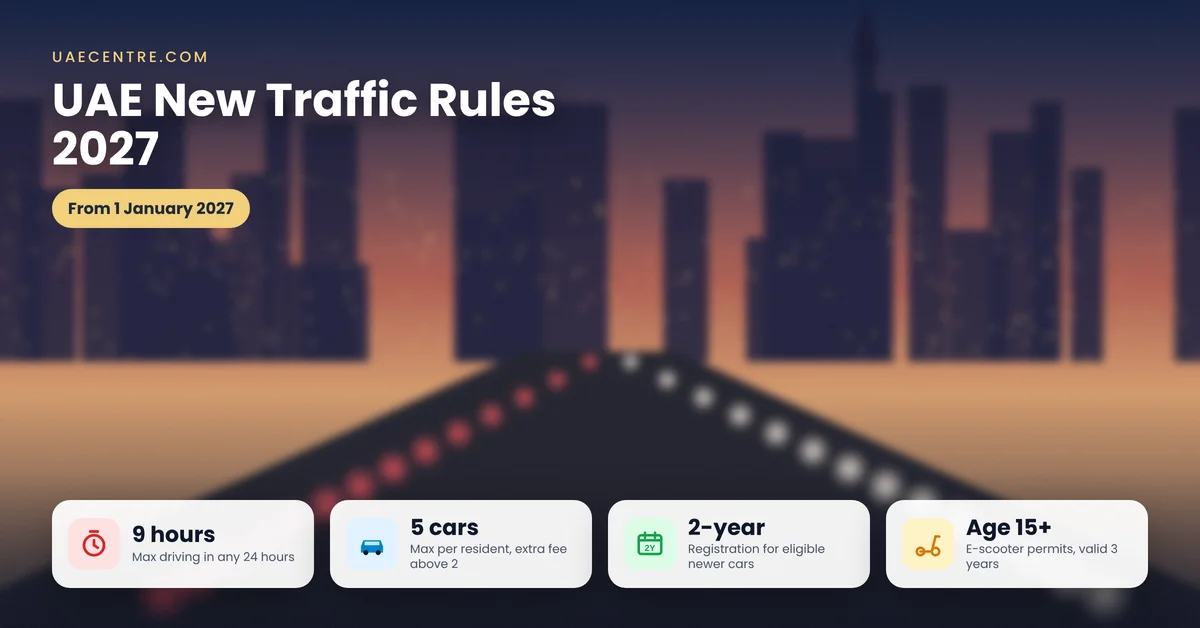
The 5 Biggest Changes at a Glance
| Change | What it means |
| Driving hours | No more than 9 hours of driving in any 24 hours, and no driving when fatigued |
| Vehicle ownership | 2 vehicles as standard; extra fee for each one above 2; maximum of 5 for individual residents |
| Licence validity | 1 year (under 21), 2 years (first licence at 21+), 5 years (expats on renewal), 10 years (UAE and GCC nationals on renewal) |
| Car registration | Option of 2-year registration for eligible newer cars owned by individuals |
| E-scooters and e-bikes | Permits from age 15, valid for 3 years, with safety equipment rules |
These rules implement the UAE’s newer federal traffic law, Federal Decree-Law No. 14 of 2024.
For Every Driver: The 9-Hour Limit
This is the change everyone’s talking about. Under the new rules:
- You must not drive for more than nine hours within any 24-hour period.
- You must not drive if fatigue or exhaustion affects your ability to drive safely, even if you haven’t reached nine hours.
The rule sits under the general duties of all drivers, not only professional ones. So it applies to private motorists too.
What we don’t know yet: the regulations don’t explain how driving hours will be monitored, whether rest breaks will be compulsory, or what the penalty will be for going over the limit. The Federal Traffic Council can also change the nine-hour limit. Expect more guidance before January.
For most people, nine hours is far more than a normal day of driving. But it matters on long road trips. Plan stops, share the driving, and stop if you feel tired.
For Professional and Delivery Drivers
If you drive for a living, this change could affect you the most. Today, 12-hour shifts are common for taxi drivers and delivery riders. Long-haul lorry drivers can work even longer.
Here’s what to expect:
- Shift patterns may change. Employers will likely need to reorganise schedules so no driver goes over nine hours of driving.
- Pay structures may change. If you’re paid per trip or per delivery, ask your employer how earnings will work with shorter driving time.
- Professional permits matter. The rules also require professional and delivery drivers to carry valid professional permits and show them when asked.
- Tracking may increase. Companies may use GPS or apps to warn drivers when they’re close to their limit.
Road safety experts have welcomed the change. Tired drivers cause many serious crashes, especially with lorries and buses. Countries like the UK and Australia already limit driving hours for heavy vehicle drivers.
Separately, Dubai plans to make smart monitoring mandatory for delivery motorcycles after June 2027.
For Car Owners: The 5-Vehicle Cap
Thinking of buying another car? Here’s how the new ownership rules work for individual residents:
- You can own two vehicles as standard.
- For each vehicle above two, you’ll pay an extra fee when registering or renewing.
- The maximum is five vehicles per individual resident.
The cap applies to individuals, not companies. Two more rules are worth knowing. Right-hand-drive vehicles can’t be licensed for road use, only for display. And cars that don’t meet safety standards won’t be licensed.
There’s also a new reason to take car recalls seriously. Owners who ignore manufacturer recalls could face restrictions on their vehicle transactions.
Two-Year Car Registration
Today, most cars are registered for one year at a time. From 2027, some owners can ask for two years, if the car meets all three conditions:
- It was brand new when first registered.
- It’s no more than six years old from its manufacturing date.
- It’s owned by an individual, not a company.
Meeting the conditions doesn’t guarantee approval. The licensing authority decides. The rules also don’t say whether there will be extra fees.
For New and Young Drivers: Licence Validity
| Driver | Licence validity |
| Under 21 | Temporary licence for 1 year, renewable for another year |
| First licence at 21 or older | 2 years |
| Expatriate residents on renewal | 5 years, renewable |
| UAE and GCC nationals on renewal | 10 years, renewable |
If you get your first licence before 21, the longer periods apply once you reach 21 and meet the requirements. New driving test rules also take effect in January 2027, so if you’re learning now, check the latest guidance. Our driving licence guide explains the current process.
For E-Scooter and E-Bike Riders
Personal mobility devices are getting clearer rules:
- Riders must be at least 15 to apply for a permit for electric scooters, electric bicycles and small motorised bikes.
- Permits are valid for three years and can be renewed.
- Devices must have front lights, red rear lights linked to braking, a horn or bell, brakes on at least the rear wheel, and safe tyres.
- Riders must use designated routes and follow speed limits.
Parents of teenagers who ride e-scooters should check their devices now. Some cheaper models may not have all the required lights or brakes.
What You Can Do Now
- Check how many cars are in your name. If it’s more than two, budget for the extra fees.
- Professional drivers: ask your employer how shifts and pay will change before January.
- Check your car’s recall status with your dealer or the manufacturer’s website.
- Check your e-scooter or e-bike has the required lights, brakes and horn.
- Plan long road trips with breaks and shared driving.
- Keep an eye on your record. Check your traffic fines regularly in the official apps.
Other Recent Road Changes
These 2027 rules come on top of other recent changes, like the new speed limits on five Dubai roads from 1 November 2026. With winter weather bringing rain to some areas, our guide to driving in bad weather is also worth a read.
Frequently Asked Questions
Final Word: Safer Roads, a Little Planning
Most of these changes are about safety. Fewer tired drivers. Safer e-scooters. Better-managed cars. For everyday drivers, little changes day to day. For professional drivers and families with many cars, it’s worth planning now. Watch for more official guidance before 1 January, especially on how the nine-hour limit will work.
Official sources: Ministry of Interior and the UAE Government portal.
This article is based on Cabinet Decision No. 174 of 2026 as reported by official and news sources up to 6 November 2026. Details may be clarified or updated before the rules take effect. Last updated: 6 November 2026.