Somewhere in the UAE right now, someone is waiting for a call. A new kidney. A new liver. A second chance.
Thousands of patients in the country are on organ waiting lists. For many of them, hope depends on people who made a simple decision years earlier: to register as an organ donor.
In the UAE, that decision takes about five minutes. Here’s how it works, what the law says, and the questions people often ask.
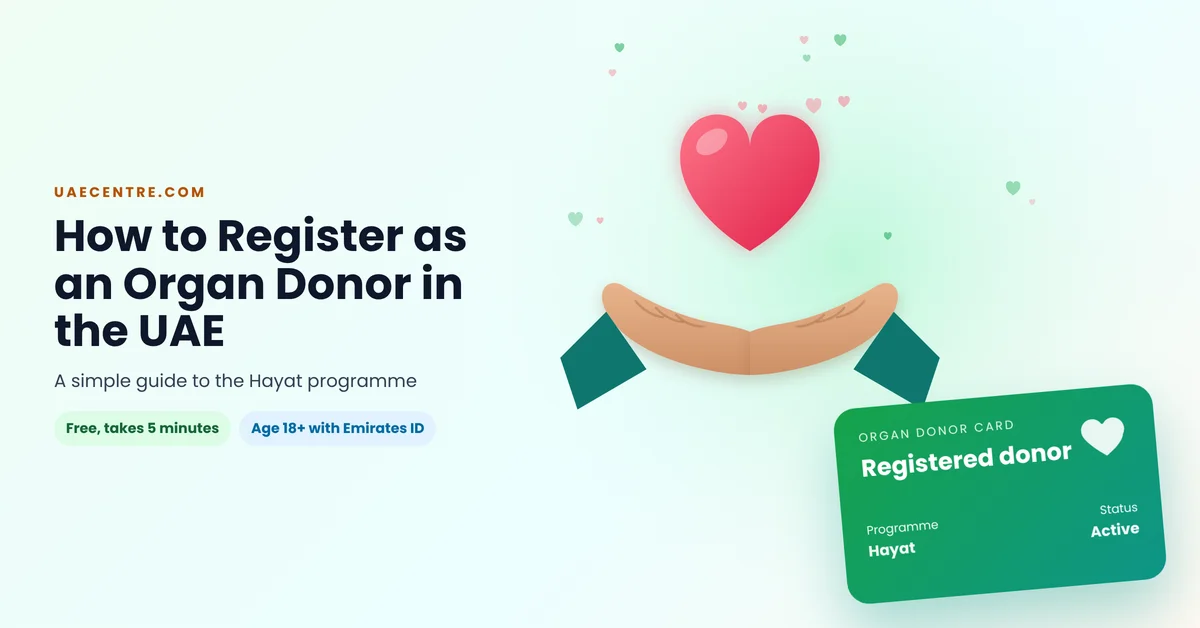
Quick answer: Any UAE resident aged 18 or over with an Emirates ID can register as an organ donor through Hayat, the national organ donation programme run by the Ministry of Health and Prevention (MoHAP). Register on the MoHAP website or the Hayat app, enter your Emirates ID details, accept the terms and you’ll get an electronic donor card straight away. Registration is free, and you can withdraw at any time.
What Is the Hayat Programme?
Hayat, which means “life” in Arabic, is the UAE’s National Programme for Donation and Transplantation of Human Organs and Tissue. It’s managed by MoHAP and works with health authorities and hospitals across the country.
Hayat keeps a national donor registry linked to your Emirates ID. When someone who registered passes away, and donation is medically possible, hospitals can see their wish and talk to their family.
Donors and recipients from more than 50 nationalities have taken part, so nationality doesn’t matter. Abu Dhabi alone has recorded around 2,500 transplant procedures since 2017.
Who Can Register?
- Anyone living in the UAE, citizen or resident
- Aged 18 or over
- With a valid Emirates ID
You don’t need to be in perfect health to register. Doctors decide which organs can be donated at the time, based on medical checks.
How to Register: Step by Step
- Go to the Hayat page on the MoHAP website, or download the Hayat app.
- Enter your details: Emirates ID number, nationality and date of birth.
- Fill in the remaining fields and choose your emirate.
- Read the terms and conditions carefully.
- Click “Consent” to confirm your wish to donate.
- Download your electronic donor card. It appears as soon as registration is complete.
Card not downloading? On some phones, pop-up blockers stop the donor card from appearing. Turn off the pop-up blocker in your browser settings, then go back to the registration page to download it.
Talk to Your Family
This is the most important step after registering. In practice, hospitals speak with families when someone passes away. If your family already knows your wish, it’s much easier for them to honour it at a very difficult time.
You don’t need a big conversation. A simple “I’ve registered as an organ donor, and it matters to me” is enough. Some people also share a copy of their donor card with close family.
What Does UAE Law Say?
Organ donation in the UAE is regulated by federal law, starting with Federal Law No. 5 of 2016 on the transplantation of human organs and tissues, which has since been updated. Some key points:
- Donation after death can only happen after death is confirmed by medical specialists.
- No payment. Buying or selling organs is a crime, with strict penalties.
- Confidentiality. The identities of donors and recipients are kept private.
- Living donation is also possible in some cases. A living donor can give a kidney or part of their liver to a relative, under strict medical and legal rules.
Can I Change My Mind?
Yes. Registration is your choice, and you can withdraw at any time. Go back to the Hayat registration page and enter your Emirates ID number, nationality and date of birth to update your choice. If you need help, MoHAP’s customer service teams can guide you.
Common Questions and Myths
| Myth | Fact |
| “If I register, doctors won’t try as hard to save me.” | Doctors’ first duty is always to save your life. Donation is only considered after death is confirmed. |
| “I’m an expat, so I can’t donate.” | Residents of any nationality with an Emirates ID can register. |
| “I’m too old or not healthy enough.” | Doctors assess each case. Many people can still donate some organs or tissues. |
| “My family will have to pay something.” | Organ donation doesn’t involve payment, either way. |
| “Once I register, I can’t change my mind.” | You can withdraw at any time. |
What About Faith?
Many people have questions about how organ donation fits with their religious beliefs. If you’re unsure, speak to a religious scholar you trust, or ask the Hayat programme team for guidance. It’s a personal decision, and it’s fine to take time to think it through.
Other Ways to Help
Not ready to register? You can still support the cause:
- Become a Hayat ambassador or volunteer to raise awareness in your community.
- Give blood at your nearest blood donation centre.
- Look after your own health. Many organ failures are linked to diabetes, high blood pressure and heart disease. Healthy eating and regular check-ups through your health insurance help prevent them.
Stay Safe From Fake Requests
Hayat registration is free, and genuine organ donation never involves money. Be careful with anyone online who offers to pay for organs, or asks for fees to “register” you. These are scams and may be illegal. Always use the official MoHAP website or app.
Frequently Asked Questions:
Final Word: Five Minutes, Many Lives
Registering as an organ donor is one of the simplest things you can do that might matter the most. It takes five minutes, it’s free, and you can change your mind any time. If it feels right for you, register today, then tell the people you love.
Official sources: MoHAP Hayat programme, Department of Health Abu Dhabi and Dubai Health Authority.
This guide is for general information and is not medical or legal advice. For questions about your situation, contact MoHAP or your doctor. Last updated: 10 November 2026.