The summer is finally over. The AC isn’t running all day anymore. Then the DEWA bill arrives, and it’s still higher than you expected.
Sound familiar? You’re not alone. Many Dubai residents pay their DEWA bill every month without really knowing what’s in it.
This guide fixes that. You’ll learn what each charge means, why bills jump, and 15 simple ways to pay less. No technical jargon, just practical steps.
Quick answer: Your DEWA bill includes electricity (23 to 38 fils per kWh, depending on how much you use), water, a monthly fuel surcharge, a sewerage fee, 5% VAT on the utility charges, and the Dubai Municipality housing fee (5% of your annual rent, split over 12 months). The biggest savings come from using the AC wisely, staying in the lowest electricity slab and cutting hot water use.
What’s Actually on Your DEWA Bill?
Your bill has more than two lines. Here’s what each one means:
| Charge | What it is |
| Electricity | What you use in kilowatt-hours (kWh), charged in slabs |
| Water | What you use, charged in slabs |
| Fuel surcharge | An extra charge per unit, linked to fuel costs. It changes every month |
| Sewerage fee | A Dubai Municipality fee based on the water you use |
| Housing fee | 5% of your annual rent, split into 12 monthly payments |
| Meter charge | A small fixed monthly charge based on your meter type |
| VAT | 5% on the utility charges, but not on the housing or sewerage fees |
You can check the latest rates on DEWA’s official slab tariff page.
DEWA Electricity Rates in 2026
DEWA charges electricity in slabs. The more you use in a month, the more you pay per unit.
| Monthly electricity use | Rate per kWh |
| 0 to 2,000 kWh | 23 fils |
| 2,001 to 4,000 kWh | 28 fils |
| 4,001 to 6,000 kWh | 32 fils |
| Above 6,000 kWh | 38 fils |
On top of this, the fuel surcharge is added to every unit. In October 2026, it’s 6 fils per kWh. It changes monthly.
Example: You use 1,500 kWh in a month. All of it is in the first slab. That’s 1,500 × 23 fils = AED 345, plus 1,500 × 6 fils fuel surcharge = AED 90. Total: about AED 435 before VAT. Now say you use 2,500 kWh. The first 2,000 units cost 23 fils, but the next 500 cost 28 fils. With the surcharge, that’s about AED 750 before VAT. Using 67% more electricity raised the cost by 72%.
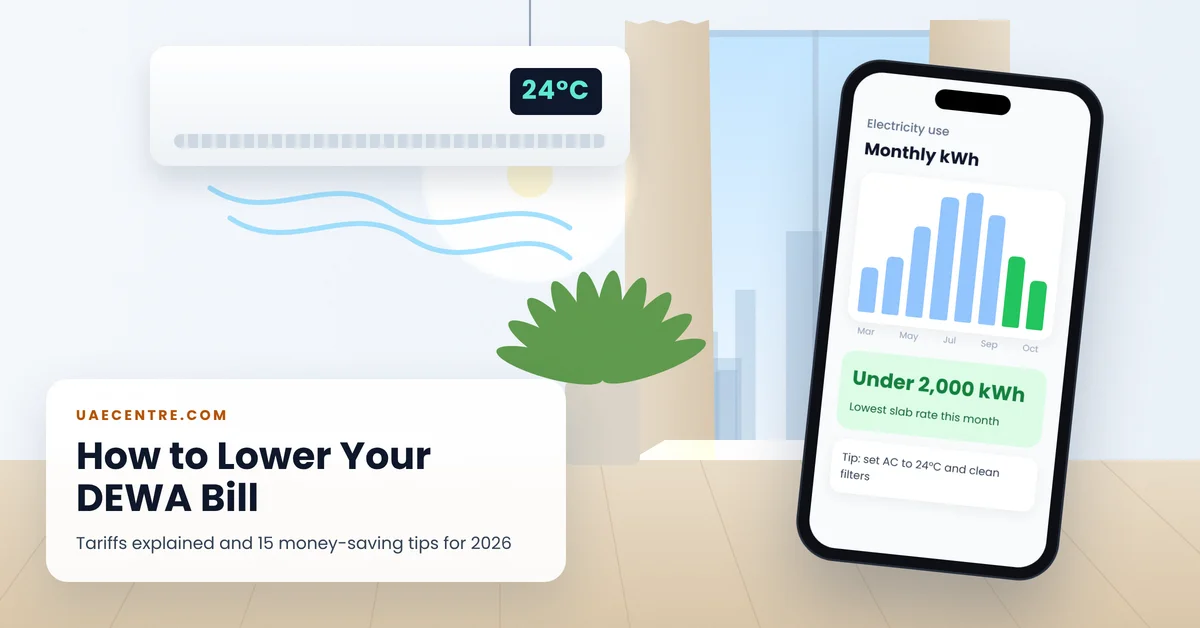
That’s why staying under 2,000 kWh a month is one of the easiest ways to save.
DEWA Water Rates in 2026
Water is also charged in slabs, per cubic metre (one cubic metre is about 220 gallons):
| Monthly water use | Rate |
| Up to 27 cubic metres | AED 7.70 per m³ |
| 27 to 54 cubic metres | AED 8.80 per m³ |
| Above 54 cubic metres | AED 10.12 per m³ |
A water fuel surcharge (AED 1.10 per m³ in October 2026) and the sewerage fee are added on top. For 2026, the sewerage fee is 2 fils per gallon of water used.
The Housing Fee: The Charge That Surprises Everyone
This one isn’t a utility at all. It’s a Dubai Municipality fee for expat tenants, collected through DEWA.
It equals 5% of your annual rent, split into 12 monthly payments. So if your rent is AED 60,000 a year, you pay AED 250 a month on top of your electricity and water.
You can’t reduce this by saving energy. It’s tied to your rent. But knowing it’s there helps you understand why your bill never drops below a certain amount. It’s also worth remembering when you plan your monthly budget and compare it with your minimum salary needs.
Why Is My DEWA Bill So High?
If your bill suddenly jumps, it’s usually one of these reasons:
- Air conditioning. In summer, AC can make up most of your electricity use.
- You crossed into a higher slab. Even a small increase can push units into a pricier band.
- The fuel surcharge changed. It moves up and down every month.
- A longer billing period. Some months cover more days than others.
- A hidden leak. A running toilet or dripping tap wastes water 24 hours a day.
- Hot water heaters left on all day. These use a lot of power.
- An unpaid balance from the previous month.
15 Easy Ways to Lower Your DEWA Bill
Air conditioning (your biggest saving)
- Set the AC to 24°C. Every degree lower makes the AC work harder.
- Clean or change AC filters every one to three months. Dirty filters waste power.
- Use timers or smart controls. Turn the AC off or up when no one’s home.
- Close doors to empty rooms. Cool only the spaces you use.
- Use curtains or blinds in the daytime to block heat from the sun.
- Use ceiling or standing fans in cooler months instead of the AC.
Electricity around the home
- Switch to LED bulbs. They use far less power and last much longer.
- Turn off appliances at the wall. TVs, consoles and chargers use power on standby.
- Put the water heater on a timer. Heat water only when you need it.
- Run washing machines and dishwashers with full loads.
- Choose energy-efficient appliances with a good star rating when you replace old ones.
Water
- Fix leaks fast. Check toilets and taps every month.
- Fit water-saving aerators on taps and showers. They’re cheap and easy to install.
- Take shorter showers. Cutting two minutes saves a lot over a month.
- Don’t leave taps running while brushing teeth or washing dishes.
Summer vs Winter: What to Expect
In Dubai, your bill follows the weather. From June to September, the AC runs almost nonstop, and bills can be two or three times higher than in winter.
From November to March, many homes need little or no AC. That’s your chance to save. Switch to fans, open windows in the cool evenings, and give your AC a service before the next summer.
A quick tip: compare each bill with the same month last year, not the month before. It gives you a fairer picture of whether you’re really using more.
Villa Owners: Is Solar Worth It?
If you own a villa, DEWA’s Shams Dubai programme lets you install solar panels on your roof and connect them to the grid. The power you make is used first in your home, and any extra is credited to your account.
It’s a bigger investment, but villas use far more electricity than flats, often in the higher slabs. That makes solar more worthwhile. Get quotes from DEWA-approved contractors, and ask them to estimate your payback time based on your past bills.
Track Your Use With the DEWA App
The DEWA app and website show your daily and monthly use. Smart meters make this even easier.
Check it once a week for a month. You’ll quickly see which days use the most power. You can also set up alerts if your use goes above a certain level. It’s the easiest way to catch problems, like a leak, before the bill arrives.
How to Pay Your Bill (and Avoid Late Problems)
Paying on time keeps things simple. You can pay through:
- The DEWA app or website
- DEWA’s quick pay option, using just your account number
- Your bank’s app or online banking
- Payment kiosks and DEWA customer happiness centres
Turn on bill reminders in the app. If a bill stays unpaid, DEWA can send a disconnection notice, and getting reconnected costs time and money. If a bill looks wrong, don’t just ignore it. Contact DEWA and ask for a check, while keeping your account up to date.
Renting? A Few Things to Know
- Who pays? Tenants usually pay DEWA bills for their own unit. Check your tenancy contract.
- Sharing a flat? Agree how to split the bill in writing before you move in. Dubai’s new shared housing rules are also worth reading.
- District cooling: in some buildings, AC is billed separately by a cooling company, not DEWA. Ask before you rent, as it can add a lot to your monthly costs.
- Faulty AC or leaks? Report them to your landlord in writing. If they’re not fixed, this can become a rental dispute.
- Moving out? Request your final bill and deposit refund through DEWA once your final reading is done.
Common DEWA Myths
| Myth | Fact |
| “Turning the AC off and on wastes more power.” | Not when you’re out for hours. Use a timer or set it higher instead of cooling an empty home. |
| “Lower AC temperature cools the room faster.” | No. It cools at the same speed. It just keeps going longer and uses more power. |
| “Standby uses almost nothing.” | Each device uses a little, but many devices on standby all month add up. |
| “My bill is high, so DEWA must have made a mistake.” | Sometimes, but check your use, the slab and the fuel surcharge first. Then contact DEWA if it still looks wrong. |
Your Monthly DEWA Checklist
- Check your use in the DEWA app and compare it with last year.
- Make sure you’re below 2,000 kWh, or see how close you are.
- Look for any sudden jump in water use. It could be a leak.
- Check that AC filters were cleaned in the last three months.
- Pay before the due date, or set up auto-pay.
Frequently Asked Questions:
Final Word: Small Habits, Real Savings
You can’t change the housing fee. But you can control how much electricity and water you use. Set the AC to 24°C, stay under 2,000 kWh when you can, fix leaks, and check your DEWA app once a week. These small habits can save you hundreds of dirhams a year, and they’re good for the planet too.
This week, DEWA is also hosting WETEX, its annual water, energy and sustainability exhibition in Dubai. It’s a good reminder that saving energy at home is part of a much bigger picture.
Official sources: DEWA slab tariff and the DEWA website.This guide is for general information. Tariffs, the fuel surcharge and fees can change, so check your own bill and DEWA’s website for the latest rates. Last updated: 21 October 2026.