Most people only think about health insurance when they need it. A child has a high fever at midnight. A tooth starts aching. Then come the questions: Am I covered? Which hospital can I go to? Will I have to pay?
In the UAE, health insurance isn’t optional for most residents anymore. Since January 2025, it’s required for private sector workers in every emirate. But the rules for who pays, and what’s covered, aren’t the same everywhere.
Here’s a clear, simple guide to UAE health insurance in 2026.
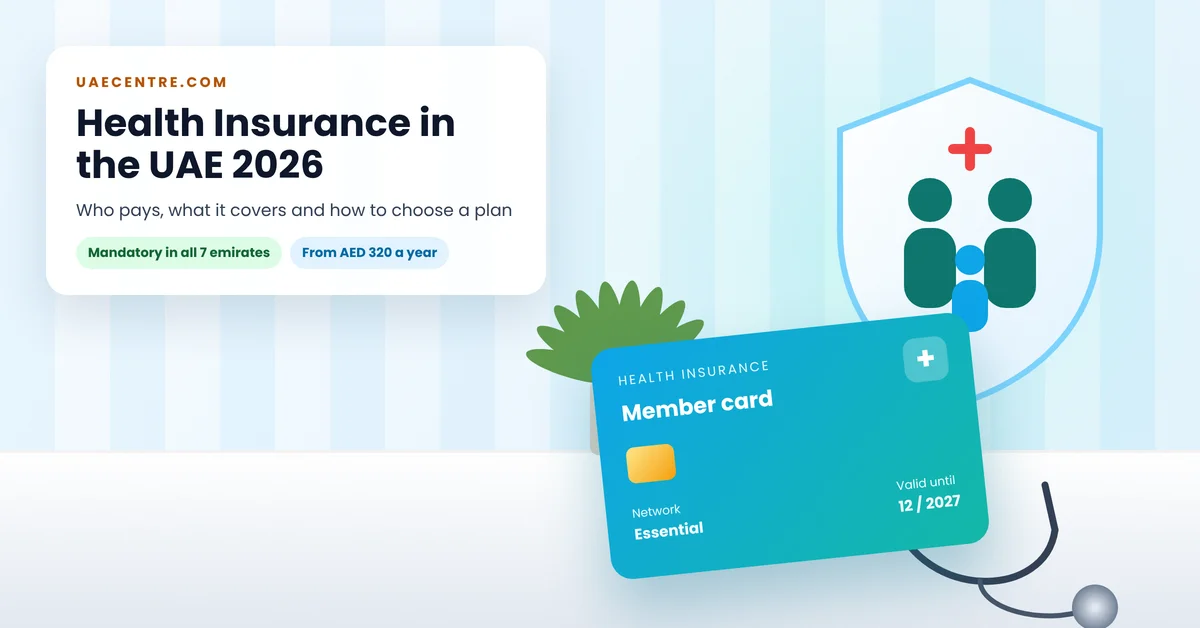
Quick answer: Since 1 January 2025, health insurance is mandatory for private sector employees and domestic workers in all seven emirates, and visas can’t be issued or renewed without it. Your employer pays for your basic cover. In Abu Dhabi, employers must also cover your spouse and up to three children under 18. In Dubai and the Northern Emirates, the employee or sponsor usually pays for family members. The basic package in the Northern Emirates costs AED 320 a year.
Is Health Insurance Mandatory in the UAE?
Yes, for most residents. Here’s how it developed:
| Emirate | Mandatory since | Who sets the rules |
| Abu Dhabi | 2006 | Department of Health Abu Dhabi |
| Dubai | 2014 | Dubai Health Authority (DHA) |
| Sharjah, Ajman, Umm Al Quwain, Ras Al Khaimah, Fujairah | 1 January 2025 | Federal scheme through MOHRE |
Today, your employer must insure you before your visa is issued or renewed. This applies to mainland and free zone firms. It also applies to people who sponsor domestic workers.
Tourists and visit visa holders aren’t covered by this rule, but travel insurance is strongly recommended. Our guide to travel insurance and flight disruptions explains what to check.
Who Pays for Your Health Insurance?
| Who needs cover | Abu Dhabi | Dubai | Northern Emirates |
| Employee | Employer pays | Employer pays | Employer pays |
| Spouse | Employer pays | Usually the employee or sponsor | Usually the employee or sponsor |
| Children | Employer pays (up to 3 under 18) | Usually the employee or sponsor | Usually the employee or sponsor |
| Domestic worker | Sponsor pays | Sponsor pays | Sponsor pays |
Some firms in Dubai and the Northern Emirates cover families too. This is more common for senior roles. Check your contract or ask HR.
Important: your employer should not deduct the cost of your mandatory cover from your salary. In Dubai, employers can be penalised for doing this. If your employer is charging you for your own basic insurance, or hasn’t insured you at all, you can file a MOHRE complaint.
What Do Basic Plans Cost and Cover?
Northern Emirates: the AED 320 Basic Package
For workers in Sharjah, Ajman, Umm Al Quwain, Ras Al Khaimah and Fujairah, the federal Basic Health Insurance Package costs AED 320 a year. Key points:
- It covers people aged 1 to 64.
- Policies are typically valid for two years.
- Pre-existing and chronic conditions are covered without a waiting period.
- It covers essential treatment within the plan’s network.
Dubai: the Essential Benefits Plan (EBP)
In Dubai, the minimum plan for lower-income employees (usually those earning under AED 4,000 a month) is the Essential Benefits Plan. Premiums are commonly around AED 550 to AED 725 a year per employee, depending on the insurer. It has an annual benefit limit of AED 150,000.
Higher earners usually get plans with more benefits, wider networks and higher limits.
Abu Dhabi
Abu Dhabi has its own minimum plans for different salary levels, set by the Department of Health. UAE nationals in Abu Dhabi are covered through the Thiqa programme.
What Basic Plans Usually Don’t Cover Well
Basic plans cover the basics. They often have limits on:
- Network: you may only be able to use certain clinics and hospitals.
- Co-payments: you may pay a share of each visit or medicine.
- Dental and optical: often not included, or very limited.
- Maternity: may be limited, or have waiting periods on some plans.
- Treatment abroad: usually not covered.
Read your policy’s table of benefits. It’s the most useful page in your insurance pack.
Insuring Your Family
Do you sponsor your spouse, children or parents? Then they need cover for their visas too. In Dubai and the Northern Emirates, you usually pay for it. The exception is if your employer covers families.
Factor this into your budget before bringing family over. Along with the minimum salary requirement for sponsoring family, insurance for each dependent is one of the main costs.
Prices for dependents vary widely by age and plan. Children’s plans are usually cheaper. Plans for parents over 60 can be much more expensive, so get quotes early.
At the Clinic or Hospital: What to Do
Going to a doctor with insurance is simple once you know the steps:
- Check your insurer’s app to find a clinic in your network.
- Take your Emirates ID and insurance card. Many clinics can look you up with your Emirates ID.
- Tell reception you’d like to use your insurance.
- Pay your co-pay, if your plan has one.
- Keep your receipts and reports.
For big tests or surgery, the clinic may need approval from your insurer first. This is called pre-approval. It can take a few hours or a day, so ask early.
In an emergency, go to the nearest emergency department. Emergencies are covered even outside your usual network on most plans. Call 998 for an ambulance.
How to Make a Claim
If you paid yourself, for example at a clinic outside your network, you may be able to claim the money back. Here’s how:
- Get an itemised bill, receipts and the doctor’s report.
- Fill in the claim form in your insurer’s app or website.
- Upload your documents and submit.
- Track the claim in the app.
Send claims as soon as you can. Many insurers have a time limit.
How to Choose a Better Plan
If you’re buying cover for your family, or upgrading your own, compare plans on these points:
- Network: are your preferred hospitals and clinics included?
- Annual limit: how much will the plan pay in a year?
- Co-pay: what percentage or fixed amount do you pay per visit?
- Maternity cover: is it included, and is there a waiting period?
- Pre-existing conditions: are they covered, and from when?
- Dental and optical: are they included or available as add-ons?
- Direct billing: can you show your card and pay only your co-pay, instead of claiming back later?
A licensed insurance broker can compare several insurers for free, as they’re usually paid by the insurer. Just make sure they’re properly licensed.
How to Check Your Cover Today
- Find your insurance card. It may be a physical card or a digital card in your insurer’s app.
- Download your insurer’s app. Most let you see your network, benefits and claims.
- Ask HR for your policy’s table of benefits if you don’t have it.
- Save your insurer’s 24/7 helpline in your phone.
- Check your family’s cards too, especially before travelling or school starting.
Common Mistakes to Avoid
- Assuming your family is covered. In most emirates, they aren’t, unless you’ve bought cover for them.
- Going outside your network for routine visits. You may pay the full bill.
- Skipping pre-approval for big tests. The claim could be rejected.
- Letting cover lapse between jobs. Ask your new employer when your cover starts.
- Not reading the benefits table. Five minutes now can save a lot of stress later.
Visa Renewal Tip
Because insurance is now linked to residence visas, an expired policy can delay your visa or Emirates ID and visa renewal. Ask HR to confirm your insurance is active a few weeks before your visa expires.
Staying Healthy Saves Money Too
Insurance helps when you’re sick, but prevention is cheaper. Small habits, like moving more and watching salt, sugar and fat in your food, reduce the risk of conditions like high blood pressure and diabetes. Many plans also include free or low-cost health checks, so use them. Frequently Asked Questions
Final Word: Know Your Cover Before You Need It
Health insurance is one of those things you hope you won’t need. But in the UAE, medical bills can add up fast without it. Take ten minutes this week to find your card, check your network and save your insurer’s helpline. If you have family here, make sure they’re covered too.
Official sources: UAE Government portal and the Dubai Health Authority.
This guide is for general information and is not insurance or medical advice. Rules, premiums and benefits vary by emirate, insurer and plan, so check your policy and official sources. Last updated: 24 October 2026.