If you share a flat in Dubai, rent a partition room, or live in a bed space, this news affects you directly.
On 7 October 2026, Dubai Municipality published its detailed guide for the new shared housing law. It names more than 44 areas where shared housing is allowed, sets a minimum room size for every person, separates families from bachelors, and gives building owners until September 2027 to comply. Fines for breaking the rules go up to AED 500,000, and double for repeat offences.
For hundreds of thousands of residents, sharing is the only affordable way to live in Dubai. So the big questions are simple: is my room legal, will I have to move, and will rent go up? This guide explains what’s changed, in plain language.
Quick answer: Under Dubai’s Shared Housing Law (Law No. 4 of 2026), shared housing is only allowed in approved areas and in buildings with a Dubai Municipality permit. Each bedroom must give at least 5 square metres per person, and buildings must be either for individuals or families, not both. Owners and leasing companies have until September 2027 to comply. Fines range from AED 500 to AED 500,000, doubling up to AED 1 million for repeat offences.
What Has Dubai Announced?
Dubai’s Shared Housing Law, Law No. 4 of 2026, came into effect on 8 September 2026. It regulates how homes can be shared by people who aren’t one family, whether that’s three friends splitting a two-bedroom apartment or a villa divided into many rooms.
On 7 October, Dubai Municipality released the Planning and Building Requirements Guide for Shared Housing and Permitted Areas. This is the practical rulebook that explains how the law works in real buildings. It covers:
- Approved areas where buildings and villas can be used for shared housing
- Minimum space per person in each bedroom
- Building categories: individual accommodation or family accommodation
- Required facilities such as kitchens, bathrooms, laundry and dining areas
- Health and safety standards, including fire safety and escape routes
- Permits, which are applied for through the Build in Dubai platform
The rules don’t cover company labour accommodation, which falls under separate legislation
Why Is Dubai Doing This?
Dubai is growing fast. More than 200,000 people moved to the emirate this year alone, putting huge pressure on housing. Many residents cope by sharing, but in some buildings that has turned into serious overcrowding.
You’ve probably seen it, or lived it: a two-bedroom flat divided into eight partitions, people sleeping in living rooms and on balconies, one bathroom for a dozen tenants, and extension cables everywhere. These setups strain kitchens, plumbing, ventilation and electrical systems. Illegal partitions can also block fire escape routes. A 2025 fire in a crowded Dubai Marina tower, home to thousands of people, exposed exactly these dangers.
The aim of the law is to keep shared housing available and affordable, but safe, healthy and properly regulated.
Which Areas Are Approved for Shared Housing?
Dubai Municipality has identified more than 44 areas where buildings and villas can be allocated for shared housing. The areas named publicly so far include:
| Approved area | General location |
| Al Souq Al Kabeer | Bur Dubai, old Dubai |
| Al Ras | Deira |
| Al Muraqqabat | Deira |
| Al Rigga | Deira |
| Al Warqa 1 | Eastern Dubai |
| Al Barsha 1 | Near Mall of the Emirates |
The full list hasn’t been published in one place yet, and the municipality says more areas will be added once approved. Most approved areas are outside the main tourist hubs. We’ll update this article as the complete list becomes available.Important: being in an approved area doesn’t automatically make a building legal for sharing.
The Key Rules Explained
1. At least 5 square metres per person
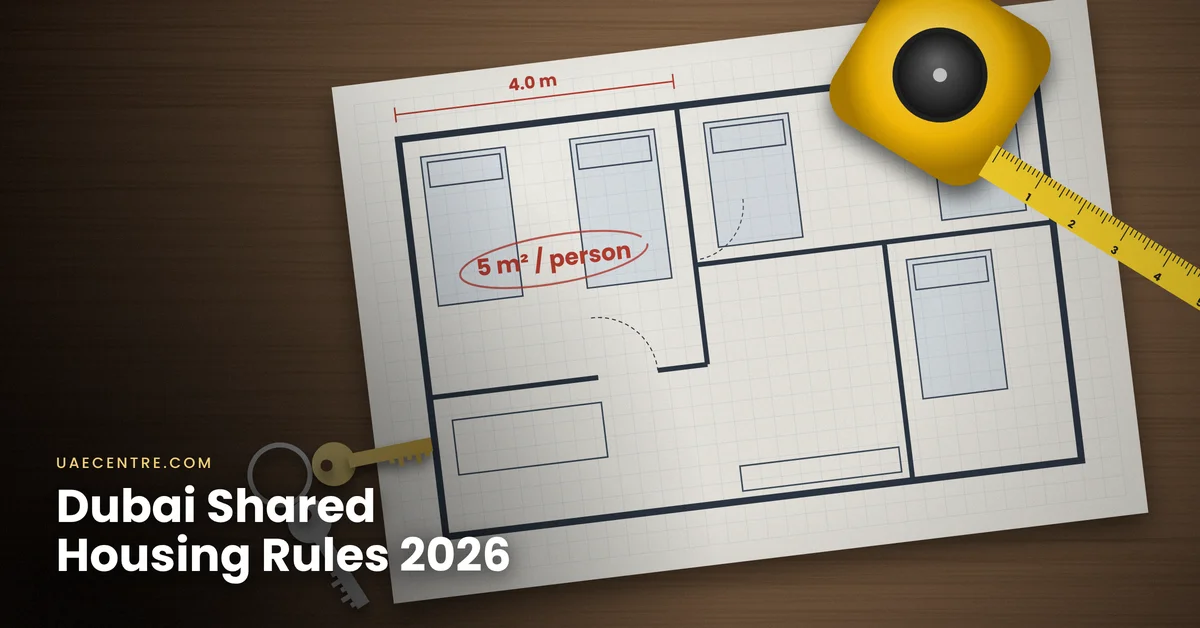
Every bedroom must provide a minimum of 5 square metres for each person sleeping in it. This is the rule most likely to affect crowded partitions and bed spaces.
Here’s what that means in practice:
| Bedroom size | Maximum people allowed |
| 5 to 9 sq m | 1 |
| 10 to 14 sq m | 2 |
| 15 to 19 sq m | 3 |
| 20 to 24 sq m | 4 |
Living rooms, balconies, kitchens and corridors aren’t bedrooms, so people sleeping there wouldn’t meet the rules.
2. Individuals or families, not both
Each shared building must be allocated to one category: individual accommodation (for example, working professionals or bachelors sharing) or family accommodation. Families and unrelated individuals can’t be mixed in the same shared unit. In family accommodation, each family must have its own bedroom with an en-suite bathroom.
3. Proper shared facilities
Buildings must have enough kitchens, bathrooms and areas for dining, recreation, laundry and drying clothes, based on how many people live there. One bathroom shared by fifteen people won’t pass.
4. A permit is required
A building or villa can only be used for shared housing after the owner gets the required permit from Dubai Municipality. Applications and renewals go through the Build in Dubai platform.
5. Six types of property can qualify
According to legal experts, six property types can be approved for shared accommodation: residential apartments, stand-alone houses, residential complexes, mixed-use buildings, adjoining houses and multi-storey buildings.
Fines for Breaking the Rules
| Violation | Penalty |
| First offence | AED 500 to AED 500,000, depending on the violation |
| Repeat offence within one year | Fine doubles, up to a maximum of AED 1 million |
The rules mainly target the people who own, manage and lease out shared properties: owners, property managers and leasing companies. That said, tenants who sublet rooms or bed spaces without permission can also get into trouble under Dubai’s tenancy rules, so don’t become an unofficial landlord yourself.
What This Means for Tenants
If you’re renting a room, partition or bed space, here’s the honest picture.
There’s no need to panic today. Owners and leasing companies have until September 2027 to bring buildings into line. No mass evictions have been announced. That said, Dubai Municipality has already started inspections in known problem areas, and some landlords may act sooner.
Some setups will change. Heavily partitioned flats, rooms with more people than the 5 square metre rule allows, and buildings that mix families with bachelors are the most likely to be affected. If you live in one of these, start planning now rather than waiting for a notice.
Rents may shift. Property experts expect the market to react before the deadline. In practice, cheap overcrowded bed spaces could become harder to find, while legal, well-run shared housing may cost a little more. Our guide to the minimum salary in UAE shows why housing costs matter so much for your overall budget.
Legal sharing protects you. A registered, permitted shared home is safer, less likely to be shut down suddenly, and gives you more security if something goes wrong.
How to Check If Your Shared Home Is Legal
- Check the area. Is your building in one of the approved shared housing areas? Watch for the full list from Dubai Municipality.
- Ask about the permit. Ask your landlord or leasing company whether the building has a Dubai Municipality shared housing permit. A legitimate operator should be able to answer clearly.
- Measure your room. Work out the floor area (length x width) and divide by the number of people sleeping in it. Less than 5 square metres each is a warning sign.
- Look at the layout. Plywood or gypsum partitions, people sleeping in the living room, and blocked corridors are red flags.
- Check your paperwork. Make sure there’s a proper tenancy contract, ideally registered through Ejari with the Dubai Land Department. You’ll need a valid Emirates ID for this.
Before you pay a deposit: ask for a written agreement, a receipt for every payment, and the landlord’s or company’s details. Cash-only arrangements with no paperwork are the riskiest, especially now.
If You Need to Move: Practical Tips
If your current setup is unlikely to meet the new standards, moving early gives you more choice and better prices. A few tips from people who’ve done it:
- Start with approved areas. Focus your search on the named shared housing areas, where legal options should grow over the coming months.
- Consider sharing a whole flat with friends. Renting a full apartment with two or three people you trust, with the contract in one person’s name and registered properly, is often safer than renting from a middleman.
- Look slightly further out. Areas a short Metro or bus ride away can offer more space for the same money. Factor in transport costs before deciding.
- Ask your employer. Some companies offer housing allowances or company accommodation. It’s worth asking, especially if the new rules make your current home unsuitable.
- Don’t hand over large deposits in cash to people offering “legal” rooms without paperwork. Scammers often follow big rule changes.
Does This Apply Outside Dubai?
No. Law No. 4 of 2026 is a Dubai law, so it applies only in Dubai. Abu Dhabi, Sharjah and the other emirates have their own rules on housing and overcrowding, and several have run their own crackdowns on illegal partitions in recent years. If you live elsewhere in the UAE, check your local municipality’s rules rather than assuming the Dubai standards apply.
Frequently Asked Questions:
Final Word: Plan Now, Not in a Panic
Dubai isn’t banning shared living. It’s trying to make it safer. If your home already meets the rules, very little changes. If it doesn’t, you have time, but not unlimited time. Check your room, talk to your landlord, and if you need to move, do it on your own schedule rather than after an inspection.
Moving to Dubai or changing jobs? Our guide to UAE Visa Rules 2026 covers the residency side of settling in.
Official source: Dubai Municipality. Tenancy registration: Dubai Land Department.
This article is based on official announcements and news reports published up to 8 October 2026. It is for general information and is not legal advice. Last updated: 8 October 2026.