It’s sports day. Your daughter is on the starting line, the whistle blows, and like every other parent there, you hold up your phone. Later that evening, the class WhatsApp group lights up with dozens of photos and videos from the day, full of other people’s children.
It feels completely normal. But in the UAE, it can cross a legal line.
This month, schools in Dubai and Sharjah have reminded parents and visitors not to photograph or film students without proper consent, and not to share images of other children on WhatsApp groups or social media. The reminder comes with a sharp edge: under the UAE’s Cybercrimes Law, privacy violations can carry prison time and fines of up to AED 500,000.
Before you panic and delete every photo on your phone, here’s what the rules actually say, what’s realistically risky, and how to keep sharing your child’s milestones without getting into trouble.
Quick answer: Don’t photograph or film other people’s children at school without consent, and don’t share images that show other students in WhatsApp groups or on social media. Follow your school’s photography policy, which may allow photos at certain events. Under Article 44 of the UAE Cybercrimes Law, privacy violations can lead to at least six months in prison and/or a fine of AED 150,000 to AED 500,000. These are maximum legal penalties for cases that amount to an offence, not automatic fines from schools.
What Have UAE Schools Announced?
Schools in Dubai and Sharjah have issued reminders to parents and visitors about photographing and filming on campus. The guidance asks families not to take photos or videos of students without appropriate consent, and not to share images that include other children through WhatsApp groups, social media or other digital platforms.
The reminders apply across the whole school environment, including:
- Classrooms and corridors
- Playgrounds and sports fields
- Assemblies, concerts and performances
- School drop-off and pick-up areas, including the gates and car park
This doesn’t mean photography is banned everywhere. Many schools allow parents to take photos at designated events, such as graduations or sports days, under specific conditions. The key message is: check your school’s policy, and get consent before capturing or sharing other children.
What Does the Law Say?
The legal basis is Article 44 of Federal Decree-Law No. 34 of 2021 on Combating Rumours and Cybercrimes, often called the UAE Cybercrimes Law. Among other things, it protects people’s privacy and makes it an offence to use technology to capture or publish images of others without their consent in a way that invades their privacy.
Depending on the circumstances, unauthorised photography of students, or sharing those images online, may count as a privacy offence. Here are the potential penalties:
| Type of violation | Potential penalty |
| Privacy violation under Article 44 | At least 6 months in prison, a fine of AED 150,000 to AED 500,000, or both |
| Digitally altered images used to defame or offend | At least 1 year in prison, a fine of AED 250,000 to AED 500,000, or both |
Keep this in perspective: these are potential legal penalties for conduct that amounts to an offence. Schools don’t hand out fines, and not every photo or school policy breach automatically attracts the maximum penalty. But the law is real, and complaints can and do reach the police and courts.
Why Is This Becoming a Big Deal Now?
Three things have changed. First, almost every parent now carries a high-quality camera, and school events produce hundreds of images in minutes. Second, WhatsApp class groups can have dozens of members, and once a photo is shared, nobody controls where it goes next. Third, AI editing tools make it easier than ever to alter children’s photos, which is exactly why the law treats manipulated images used to defame or offend even more seriously.
Not every family is comfortable with their child’s image being shared. Some have safety concerns, custody arrangements or cultural and religious reasons. Others simply want control over their child’s digital footprint. The school’s job is to protect every child, not just the ones whose parents are happy to share.
What’s Generally Fine and What’s Risky
| Usually fine | Risky (avoid without consent) |
| Photos of your own child where no other children are identifiable | Photos or videos where other children’s faces are clear |
| Photos at events where the school explicitly allows photography, following its rules | Filming in classrooms, corridors or playgrounds without permission |
| Sharing your own child’s photos privately with family | Posting images of other students in WhatsApp groups or on social media |
| Official photos the school shares through its own channels, used as the school allows | Re-sharing other parents’ photos that show children who aren’t yours |
| Group photos where every family has given consent | Filming teachers or staff without their permission |
| Editing, filtering or using AI tools on other children’s images |
Notice the theme: it’s not your own child that’s the problem. It’s everyone else in the frame.
WhatsApp Groups: The Biggest Risk for Parents
Class WhatsApp groups are incredibly useful for reminders and homework updates, but they’re also where most photo problems happen. A parent shares a sweet group photo from a class party, another forwards it to their family group, someone posts it on Instagram, and within an hour an image of a child whose parents never agreed is circulating far beyond the school.
Some simple group habits make a big difference:
- Agree on a group rule: no photos of children other than your own, unless every family in the photo has said yes.
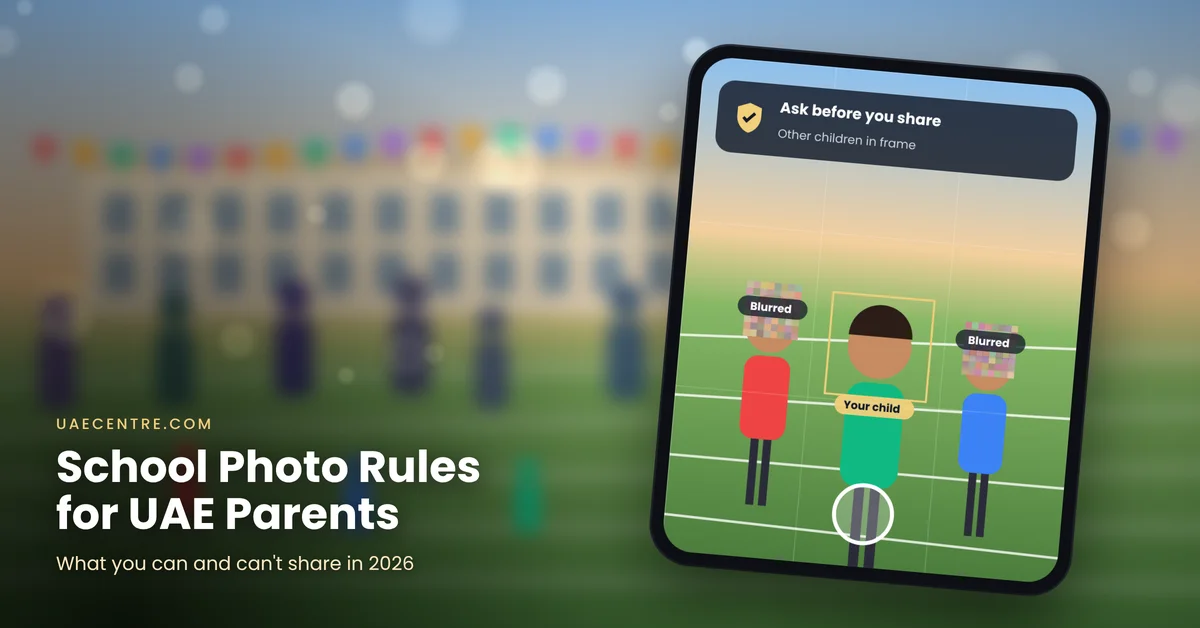
- Crop or blur other children before sharing anything.
- Don’t forward photos from the class group to other groups or social media.
- Delete on request. If a parent asks for an image of their child to be removed, remove it straight away, no debate.
- Let the school share official event photos through its own approved channels.
Teachers and Staff Have Privacy Too
The same privacy protections apply to adults. Filming a teacher during a parents’ evening, recording a heated conversation at the school gate, or posting a staff member’s photo to complain about them online can also create legal problems. If you have a concern about a teacher or school decision, raise it in writing through the school’s official complaints process instead of social media.
How to Share Your Child’s Milestones Safely
You don’t have to give up on capturing memories. A few habits keep you on the right side of the rules:
- Frame tightly. Get close and focus on your own child, or shoot from an angle where others aren’t identifiable.
- Use editing tools to blur faces of other children before sharing, rather than to change anyone’s appearance.
- Share privately. Send photos directly to grandparents and family instead of posting publicly.
- Check your privacy settings on social media, and think twice before posting children’s photos publicly at all, even your own.
- Ask first. If you want to share a photo with friends’ children in it, a quick message to their parents is all it takes.
- Follow the school’s photo policy at events, including any “no phones” moments the school announces.
A 10-Second Checklist Before You Press Send
Before sharing any photo taken at school or a school event, run through these quick questions:
- Is anyone else’s child clearly visible? If yes, crop, blur or ask their parents first.
- Was photography allowed at this moment? If the school asked for phones away, don’t share it.
- Where is it going? A private message to grandma is very different from a 60-member group or a public post.
- Could it embarrass anyone? Photos of children crying, changing, falling or being told off should never be shared.
- Has anything been edited? Never alter another child’s image, even as a joke.
If any answer makes you pause, don’t send it. It takes ten seconds, and it could save a lot of trouble later.
What If Someone Shares Your Child’s Photo Without Consent?
If an image of your child is shared in a way you’re not comfortable with, here’s a calm, step-by-step approach:
- Ask for removal directly. Most parents will delete the photo immediately when asked politely.
- Tell the school. Schools take these reminders seriously and can address it with the parent or within the group.
- Keep evidence. Take screenshots showing the image, where it was posted and when, in case you need them later.
- Report serious cases. If the image is misused, altered or spread maliciously, you can report it to the police, for example through Dubai Police’s eCrime platform or your local police service.
Talk to Your Children Too
Many children now have phones or smartwatches with cameras. It’s worth explaining the same rules to them: don’t take photos of classmates without asking, don’t share pictures of friends in group chats, and never edit someone’s photo to make fun of them. Learning digital respect early protects them, and their friends, for years to come.
The same applies on family days out. During the mid-term break and the busy winter season ahead, be mindful of other children appearing in your photos at parks, attractions and events.
Part of a Wider Set of October Rule Changes
The school photography reminder is one of several rule changes residents are hearing about this month. Others include new limits on salt, sugar and fat in some packaged foods, changes to the law on attempted suicide, and Dubai’s new shared housing rules. If you live in the UAE, it’s a good month to catch up on what’s changed.
Frequently Asked Questions:
Final Word: Capture Your Child, Respect Everyone Else’s
Nobody is trying to stop parents from celebrating their children. The message from UAE schools is simply about respect and consent. Focus your camera on your own child, ask before sharing anyone else’s, and let the school handle official photos. Those small habits protect every family in the class, including yours.
Official source: UAE Government portal.
This article is for general information and is not legal advice. It is based on news reports and school guidance published up to 13 October 2026. For specific situations, check your school’s policy or consult a UAE lawyer. Last updated: 13 October 2026.